Reports bringing up the statistical history of the European Army in India and of the Native Army and jail population of Bengal to 1876 : and the cholera history of 1875 and 1876, in continuation of reports embracing the period from 1817 to 1872 / by J.L.Bryden.
- James Bryden
- Date:
- 1878
Licence: Public Domain Mark
Credit: Reports bringing up the statistical history of the European Army in India and of the Native Army and jail population of Bengal to 1876 : and the cholera history of 1875 and 1876, in continuation of reports embracing the period from 1817 to 1872 / by J.L.Bryden. Source: Wellcome Collection.
Provider: This material has been provided by Royal College of Physicians, London. The original may be consulted at Royal College of Physicians, London.
300/358 (page 278)
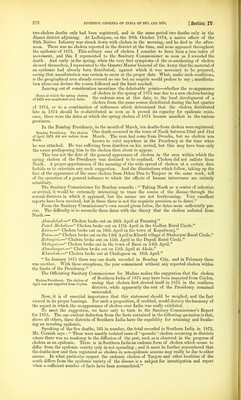
![two cliolera deaths only had been registered, and in the same period two deaths only in the Jhansi district adjoining. At Lullutpore, on the 28th October 1874, a native officer of the 28th Native Infantry was struck down with cholera in the morning, and he died in the after- noon. There was no cholera reported in the district at the time, and none appeared throughout the epidemic of 1875. This solitary case of cholera I consider to have been a true index of movement, and this I represented to the Sanitary Commissioner as soon as I recorded the death. And early in the spring, when the very first symptoms of the re-awakening of cholera showed themselves, I represented to the Quarter Master General of the Army that the material of an epidemic had already been distributed, against which it was necessary to be prepared, seeing that manifestation was certain to occur at the proper date. What, under such conditions, is the geographical area already covered no one but an empiric would profess to say ; manifesta- tion alone can declare the course followed and the limit reached. Leaving out of consideration meantime the debateable points—whether the re-appearance ^ . , , of cholera in the spring of 1875 was due to a new cholera leaving Dates at winch the spring cholera ,i j ■ ^i? of 1875 was manifested over India. ^hs endemic area at this date, to the local development or a cholera from the same source distributed during the last quarter of 1874, or to a combination of influences which determined that the cholera distributed late in 1874 should be re-distributed as soon as it proved its capacity for epidemic exist- ence, these were the dates at which the spring cholera of 1875 became manifest in the various provinces. In the Bombay Presidency, in the month of March, ten deaths from cholera were registered. Bombay Presidency. The cholera Oi^e death occurred in the town of Nasik between 22nd and 31st of April 3 875 did not radiate from March. The man had come from Dwarka, but no cholera was N^'''- known to exist anywhere in the Presidency at the time when he was attacked. He was suffering from diarrhoea on his arrival, but this may have been only the cause predisposing him to the cholera then about to appear. This was not the date of the general appearance of cholera in the area within which the spring cholera of the Presidency was destined to be confined. Cholera did not radiate from Nasik. A proper apprehension of the meaning of the wide spread of cholera at a certain date forbids us to entertain any such suggestion. And the illustrations which follow, taking up the fact of the appearance of the same cholera from Dehra Dun to Tanjore in the same week, tell of the operation of a general influence to which the effects of human intercourse are entirely subsidiary. The Sanitary Commissioner for Bombay remarks : Taking Nasik as a centre of infection or revival, it would be extremely interesting to trace the course of the disease through the several districts in which it appeared, but the means are not forthcoming. Very excellent reports have been received, but in these there is not the requisite precision as to dates. From the Sanitary Commissioner's own record given below, the dates seem sufficiently pre- cise. The difficulty is to reconcile these dates with the theory that the cholera radiated from Nasik:— Ahnedahad.— Cholera broke out on 30th April at Purantej. Tatich Mahals.— Cholera broke out on 17th April in the Godhra Rural Circle. Kaira.— Cholera broke out on 16th April in the town of Kapadwanj. Tanua.— Cholera broke out on the 14th April in Khurdi village of Shaharpur Rural Circle. Matnagiri.— Cholera broke out on 15th April in the Dapuli Rural Circle. Sholajmr.— Cholera broke out in the town of Barsi on 24th April. Ahmednagar.— Cholera broke out on 15th April at Akola. Khandesh.— Cholera broke out at Chalisgaon on 16th April. In January 1875 there was one death recorded in Bombay City, and in February there was another. With these exceptions, the year commenced without any reported cholera within the limits of the Presidency. The Officiating Sanitaiy Commissioner for Madras makes the suggestion that the cholera „ , „ ., , , of Southern India of ] 875 mav have been imported from Ceylon, Madras Presidency. The cholera of . . , , n i -i ' i -i. m ■ Tonr • j.i April was not imported from Ceylon, seeing that cholera nrst showed itselr m 1875 in the southern districts, while apparently the rest of the Presidency remained uninvaded. Now, it is of essential importance that this statement should be weighed, and the fact viewed in its proper bearings. For such a proposition, if credited, would destroy the harmony of the aspect in which the re-appearance of cholera over India was really exhibited. To meet the suggestion, we have only to turn to the Sanitary Commissioner's Report for 1873. The one evident deduction from the facts contained in the following quotation is that, above all others, these districts of Southern India have the capability for retaining and localis- ing an invading epidemic. Speaking of the few deaths, 165 in number, the total recorded in Southern India in 1873, Mr. Cornish says : These were mostly isolated cases of 'sporadic' cholera occurring in districts where there was no tendency to the diffusion of the pest, such as is observed in the progress of cholera as an epidemic. There is in Southern India an endemic form of cholera which seems to differ from the epidemic variety only in not spreading ; and it must be further remembered that the deaths now and then registered as cholera in non-epidemic seasons may really be due to other causes. In what particular respect the endemic cholera of Tanjore and other localities of the south differs from the epidemic variety of the disease is a subject for investigation and report when a sufficient number of facts have been accumulated.](https://iiif.wellcomecollection.org/image/b24749333_0302.jp2/full/800%2C/0/default.jpg)