Reports bringing up the statistical history of the European Army in India and of the Native Army and jail population of Bengal to 1876 : and the cholera history of 1875 and 1876, in continuation of reports embracing the period from 1817 to 1872 / by J.L.Bryden.
- James Bryden
- Date:
- 1878
Licence: Public Domain Mark
Credit: Reports bringing up the statistical history of the European Army in India and of the Native Army and jail population of Bengal to 1876 : and the cholera history of 1875 and 1876, in continuation of reports embracing the period from 1817 to 1872 / by J.L.Bryden. Source: Wellcome Collection.
Provider: This material has been provided by Royal College of Physicians, London. The original may be consulted at Royal College of Physicians, London.
303/358 (page 281)
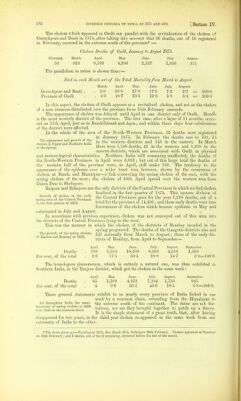
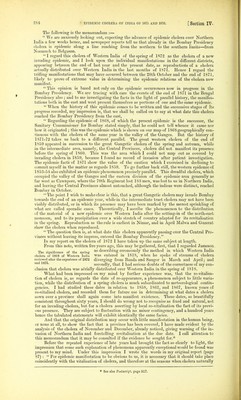
![Just as at Nasikj and in the same weekj an outbreak occurred at Jaleysur in the Agra district^ in anticipation of the cholera due three weeks later ; and between the 12th and 15th April, the indices showing the existence of the repressed cholera appeared, Saint Peter^s College, which suffered in the preceding epidemic, again showing the earliest predisposition to the attack. In the Central Provinces with the exception of the Tapti and Western Nerbudda districts Area of repression in the Central «^ ™^ ^^'^ Raipur and Bilaspur districts in the east Provinces, which are naturally associated with the cholera of Bengal, up to the end of iMay the cholera registration was nearly a blank : Jubbulpore gave 3 deaths, Murwara, in the Vindhyan tract, 18 ; and Betul 12. This cholera spread neither in Jubbulpore nor Murwara, and Betul did not register another case until July. Jubbulpore, the great railway centre, tapping the cholera-stricken Nerbudda Valley on the one hand and the cholera-stricken Gangetic Valley on the other, returned for the whole of 1875, 1] deaths only out of a resident population of 383,000, and this not as a consequence of the inability of cholera to localise itself, for this same district lost nearly 8,000 of its population in the epidemic of 1868-69. While the Nerbudda and Tapti districts immediately to the north suffered throughout Repression in four districts of the ^V^f. ^^^^^ ^^'^ il ^l ^''^^ t Berais. SIX districts 01 the Berars, and these the most westerly. Not a single death was registered in the four remaining districts lying to the east—Basira, Amraoti, EUichpur, and Wun. In the north of the Bombay Presidency the spring cholera had firmly established itself, adapt- „ , „ -1 i„^„ ing its manifestation to the local influences, the parallel manifesta- Geography of the spring cholera ■, , -, , t •j.t.t - £ r-. ^^ of Bombay. tion being delayed by a month as compared with that or Oudh and the valley of the Ganges. From Ahmedabad in the north to Poena in the south, cholera was universal in April and May, and no district escaped. Ratnagiri afforded 11 deaths, and Sholapur a single fatal case in April and May ; and, with these excep- tions, not one death was registered in any district farther south, and Sind to the west abso- lutely escaped until Novemberj with the reservation that one death did occur at Kurrachee in July.* Leaving out 10 deaths in Malabar spread over the first six months of 1875, and evidently The area iu Western and South- ^^^^ ^0 erroneous registration—no death from cholera was re- ern India which was unoccupied by corded in any district between the occupied area of Bombay spring cholera. and the districts occupied in Southern India. In none of these districts of Bombay or Madras did cholera show itself before the setting-in of the monsoon; and the alternative is, to reckon that cholera moved upon them with the monsoon influence, or that the repression over this tract was absolute up to the last ten days of June. These actual facts regarding the repression of the cholera of 1875 within areas, or the ab- sence of the materies from areas subsequently covered, clear the ground for the consideration of the next question—When did the cholera, distributed as here recorded, come into active epidemic existence and move upon areas previously free ? ^ , n> i- 4,1 i t c t I have spoken of the localisation of cholera in Goruekpore Goruckpore and Busti, the tract first ., , • n t i ^o«^ i i ^^ J.^ j_ c tT aiiected by the new epidemic.! The and Busti trom July 1874 onwards, when all the rest ot India aspect in tliis tract of the cholera of bcyond the endemic area was free from cholera. The deaths the eud of 1874 and spring of 1875. ^ijg months were as under— June. July. August. September. October. November. December. 0 17 161 1,278 3,393 689 S9 In January and February 1875 not a single death was registered. Cholera re-appeared in March, and the mortality ran thus :— March. April. May. June. July. August. 311 2,457 1,719 1,082 443 166 Nineteen cholera deaths in all occurred in the province of Oudh from September to December 1874, and 16 of these, which occurred in Fyzabad in November and December and to which I have already referred, I reckon to have been the precursors of the epidemic cholera of 1875. In all Oudh north of the Gogra, one of the most deadly cholera tracts of India and geographically continuous, there was not a single cholera death in the late months of 1874, when Busti and Goruckpore were suffering; and Jaunpore to the south, out of a population of a million, registered only 4 deaths fi'om July to December 1874. We know from experience that the earliest appearance of cholera in Eastern and Northern The re-invasion of Oudh. ^^^^ ^^^'^^ ^luce, as the rule, about the 20th February, and that the 20th March is for the same tract the date of general epidemic appearance, anticipating by a month the cholera due to appear elsewhere on 20th April. This has to be taken into account when we are told that cholera has been imported. * The siugle outbreak in Siud, which resulted in 42 deaths, was confined to one registration circle of the Kurrachee district.](https://iiif.wellcomecollection.org/image/b24749333_0305.jp2/full/800%2C/0/default.jpg)