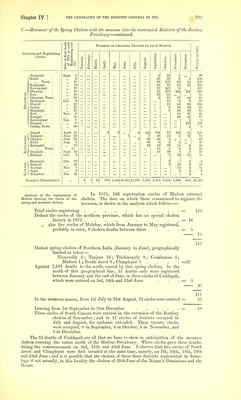
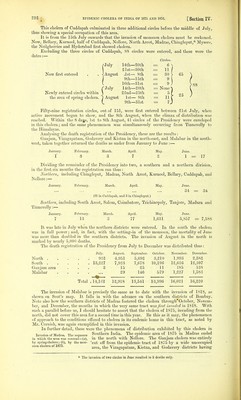
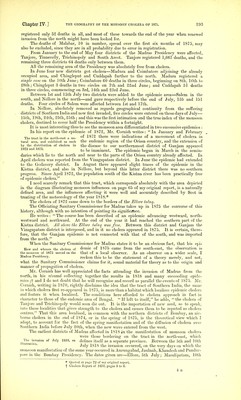
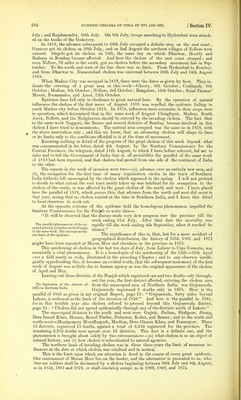
Reports bringing up the statistical history of the European Army in India and of the Native Army and jail population of Bengal to 1876 : and the cholera history of 1875 and 1876, in continuation of reports embracing the period from 1817 to 1872 / by J.L.Bryden.
- James Bryden
- Date:
- 1878
Licence: Public Domain Mark
Credit: Reports bringing up the statistical history of the European Army in India and of the Native Army and jail population of Bengal to 1876 : and the cholera history of 1875 and 1876, in continuation of reports embracing the period from 1817 to 1872 / by J.L.Bryden. Source: Wellcome Collection.
Provider: This material has been provided by Royal College of Physicians, London. The original may be consulted at Royal College of Physicians, London.
314/358 (page 292)
![This cholera of Cuddapah culminated in three additional circles before the middle of July, thus showing a special occupation of this area. It is from the 15th July onwards that the invasion of monsoon cholera must be reckoned. Now, Bellary, Kurnool, half of Cuddapah, Nellore, North Arcot, Madras, Chingleput,*' Mysore, the Neilgherries and Hyderabad first showed cholera. Excluding the three circles of Cuddapah, 88 circles were entered, and these were the dates:— Now first entered Circles. rJuly 14th—20th 21st—80th = 1 August Jst— 8th ^ 30 } 9th—15th = 9 16th—31st = 9 J 'July 14th—20th = None 'J bin I 22nd—25th August 1st— 8th i ■! 9th—31st 65 •88 23 Fifty-nine registration circles, out of 151, were first entered between 21st July, when active movement began to show, and the 8th August, when the climax of distribution was reached. Within the 8 da]^, 1st to 8th August, 41 circles of the Presidency were enveloped in this cholera; and the same phenomenon was simultaneously occurring from Tinnevelly to the Himalayas. Analysing the death registration of the Presidency, these are the results : Ganjam, Vizagapatam, Godavery and Kistna in the north-east, and Malabar in the south- west, taken together returned the deaths as under from January to June :—• January. February. March. April. May. June. r 3 3 7 2 1 = 17 Dividing the remainder of the Presidency into two, a southern and a northern division, in the first six months the registration ran thus : Northern, including Chiugleput, Madras, North Arcot, Kurnool, Bellary, Cuddapah, and I^ellore:— January. February. March. April. May. June. 34 = 34 (31 in Cuddapah, and 3 in Chingleput.) SoidJiern, including South Arcot, Salem, Coimbatore, Trichinopoly, Tanjore, Madura and Tinnevelly:— January. February. March. April. May. June. 7 13 3 77 1,631 5,857 = 7,588 It was late in July when the northern districts were entered. In the south the cholera was in full power; and, in fact, with the setting-in of the monsoon, the mortality of June was more than doubled in the southern districts. The invasion of August in the north is marked by nearly 5,000 deaths. The death registration of the Presidency from July to December was distributed thus : North . South . Ganjam area Malabar July. August. September. October. November. December 932 4,951 5,692 3,210 1,993 2,382 . 13,227 7,923 7,678 10,196 12,616 12,107 3 15 25 11 185 138 29 146 579 1,227 1,583 Total . 1^162 12,918 13,541 13,996 16,021 16,220 The invasion of Malabar is precisely the same as to date with the invasion of 1818, as shown on Scot's map. It falls in with the advance on the southern districts of Bombay. Note also how the southern districts of Madras fostered the cholera through October, Novem- ber, and December, the months in which the very same tract wasjirsf invaded in 1818. With such a parallel before us, I should hesitate to assert that the cholera of 1875, invading from the north, did not cover this area for a second time in this year. Be this as it may, the phenomenon of approach to the conditions offered to cholera in its endemic home in this tract, as noted by Mr. Cornish, was again exemplified in this invasion. In further detail, these were the phenomena of distribution exhibited by this cholera in Invasion of Madras. The sequence Southern India. _ The epidemic area of 1875 in Madras ended in which the area was covered—(a), m the north With NcUore. The Ganjam cholera was entirely by spring cholera; (&), by the mon- cut off from the epidemic tract of 1875 by a wide unoccupied soon cholera of 1875. Vizagapatam, Kistna, and Godavery districts having * The invasion of two circles in June resulted in 3 deaths only.](https://iiif.wellcomecollection.org/image/b24749333_0316.jp2/full/800%2C/0/default.jpg)