Reports bringing up the statistical history of the European Army in India and of the Native Army and jail population of Bengal to 1876 : and the cholera history of 1875 and 1876, in continuation of reports embracing the period from 1817 to 1872 / by J.L.Bryden.
- James Bryden
- Date:
- 1878
Licence: Public Domain Mark
Credit: Reports bringing up the statistical history of the European Army in India and of the Native Army and jail population of Bengal to 1876 : and the cholera history of 1875 and 1876, in continuation of reports embracing the period from 1817 to 1872 / by J.L.Bryden. Source: Wellcome Collection.
Provider: This material has been provided by Royal College of Physicians, London. The original may be consulted at Royal College of Physicians, London.
325/358 (page 303)
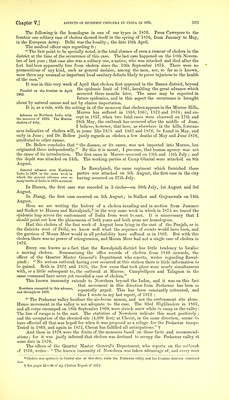
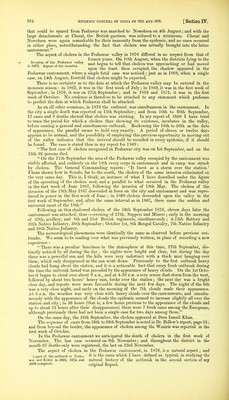
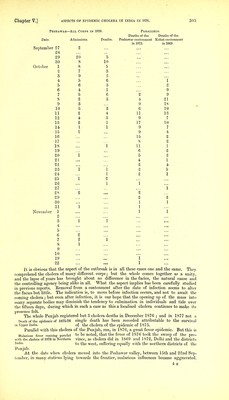
![The following is the homologne in one of our types in 1876. From Cawnpore to the frontier one solitary case of cholera showed itself in the spring- of 1876^ from January to May, in the European Army. Delhi was the locality; the date 10th April. The medical officer says regarding it: The first point to be specially noted, is the total absence of even a rumour of cholera in the district at the time of the occurrence of this case. The last case happened on the 10th Novem- ber of last year; that case also was a solitary one, a native, who was attacked and died after the fort had been apparently free from cholera since the 10th September 1875. There were no premonitions of any kind, such as general malaise, among the men, nor, so far as is known, were there any unusual or important local sanitary defects likely to prove injurious to the health of the men. It was in. this very week of April that cholera first appeared in the Bannu district, beyond Parallel on the frontier in April epidemic limit of 1861, heralding the great advance which 1862. occurred three months later. The same may be expected iu future epidemics, and in this aspect the occurrence is brought about by natural causes and not by chance importation. It is, as a rule, with the setting in of the monsoon that cholera appears in the Murree Hills. Murree has suffered in 1858, 1867, 187)2 and 1876; and ex- thfjr^orof r87r\t''MuT;S ^^P* I857 when two fatal cases were observed on 17th and cholera of July. 28th May, the outbreak has occurred after the middle of J une. I believe, however, that here, as elsewhere in the hills, forerun- ners indicative of cholera will, in years like 1858 and 186i and 1876, be found in May, and early in June; and Dr. Bellew justly regards as cholera a few deaths of May and June 1876, attributed to other causes. Dr. Bellew concludes that the disease, or its cause, was not imported into Murree, but originated there independently. By this it is meant, I presume, that human agency was not the cause of its introduction. The first cases in Murree occurred on 13th and 15th July; and the depot was attacked on 24th. The working parties at Camp Gharial were attacked on 8th August. General advance over Northern Rawalpindi, the same regiment which furnished these India in 1876 in the same week iu parties was attacked on 5th August, the first case in the city which the general advance over so having OCCUlTcd Oil 27th July, many tracts of India in 1875 occurred. In Hazara, the first case was recorded in 3 circles—on 30th July, 1st August and 3rd August. In Jhang, the first case occurred on 5th August; in Sialkot and Gujranwala on 14th August. Here we are writing the history of a cholera invading and in motion from Jummoo and Sialkot to Hazara and Rawalpindi,* in the very same week in which in 1875 we traced the epidemic leap across the cantonment of India from west to east. It is unnecessary that I should point out how the phenomena of both years and both areas are homologous. Had this cholera of the first week of August been lying iu the east of the Punjab, or in the districts west of Delhi, we know well what the sequence of events would have been, and the garrison of Mecan Meer would in all probability have suffered as in 1862. But with this cholera there was no power of retrogression, and Meean Meer had not a single case of cholera in 1876. Every one knows as a fact that the Rawalpindi district has little tendency to localise a moving cholera. Summarising the office records of cholera from 1849 onwards, the officer of the Quarter Master General's Department who reports, writes regarding Rawal- pindi : No serious outbreak having ever occurred at this station there is little information to be gained. Both in 1872 and 1876, the few cases that took place were nearly simultaneous with, or a little subsequent to, the outbreak at Murree. Campbellpore and Talagaon in the same command have never yet recorded a case of cholera. This known immunity extends to Nowshera beyond the Indus, and it was on this fact that movement in this direction from Peshawar has been so andT£oughouri87a repeatedly .urged. This has been constantly reiterated, and thus I wrote iu my last report, of 1872 : The Peshawar valley localises the air-borne miasm, and not the cantonment site alone. Hence movement in the valley is not adequate to the case. The 93rd Highlanders in 1862, and all corps encamped on 18th September 1869, were struck anew while in camp in the valley. The line of escape is to the east. The statistics of Nowshera indicate this most positively; and the occupation of the elevated site (4,400 feet) at Cherat, in the same direction, seems to have effected all that was hoped for when it was pro])osed as a refuge for the Peshawar troops. Tested in 1869, and again in 1872, Cherat has fulfilled all anticipations. f And these in 1876 were the fruits of the measures based on these facts .and recommend- ations; for it was justly inferred that cholera was destined to occupy the Peshawar valley at some date in 1876. The officer of the Quarter Master General's Department, who reports on tlie outbreak of 1876, writes : The known immunity of Nowshera was taken advantage of, and every man * Cholera was epidemic iu Caubul also at this date, while the Peshawar valley and the frontier districts remained free. t See pages 42—46 of my Cholera Report of 1872.](https://iiif.wellcomecollection.org/image/b24749333_0327.jp2/full/800%2C/0/default.jpg)