Reports bringing up the statistical history of the European Army in India and of the Native Army and jail population of Bengal to 1876 : and the cholera history of 1875 and 1876, in continuation of reports embracing the period from 1817 to 1872 / by J.L.Bryden.
- James Bryden
- Date:
- 1878
Licence: Public Domain Mark
Credit: Reports bringing up the statistical history of the European Army in India and of the Native Army and jail population of Bengal to 1876 : and the cholera history of 1875 and 1876, in continuation of reports embracing the period from 1817 to 1872 / by J.L.Bryden. Source: Wellcome Collection.
Provider: This material has been provided by Royal College of Physicians, London. The original may be consulted at Royal College of Physicians, London.
331/358 (page 309)
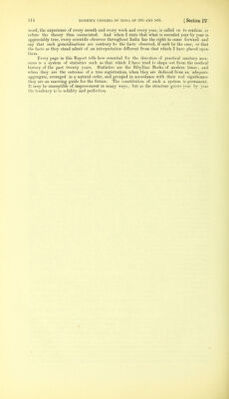
![Chapter VI- ] conclusions suggested by the study of the cholera ok 1875-76. Central Jails of the North- JFestern Provinces and Oudh, 1867—76. Benares. Allahabad. Fatehgarh. Bareilly. Agra. Meerut. Lucknow. Aggregate strength of the ten years .... 14,027 19,590 8,632 13,765 18,567 11,499 17,300 Deaths from all causes . . 422 534 125 581 395 946 358 Cholera deaths ... 6 16 2 6 8 16 3 Out of 3,361 deaths in these great jails spread over ten years, 57 only were caused by cholera. It is very certain that prison communities, shut up daily at sunset, enjoy a most remarkable immunity from cholera as well as from malarious fevers, probably due to this very cause. But yet, again, how shall we, on these grounds merely, reconcile these results with the experience of the previous decade ? Against these 57 deaths, 1,147 deaths from cholera appear in the records of the same seven jails in the ten years preceding. Cholera Deaths of the Central Jails of the North-Western Provinces and Oudh, 1857—66. Benares. Allahabad. Fatehgarh. BareiUy. Agra. Meerut. Lucknow. 153 120 25 7 321 337 185 Loss of the same Jails in 1856. 7 19 36 65 232 90 No jail. North of Benares there was in the mutiny year no prison population which furnished returns; and substituting the mortality of 1856 for that of 1857, we find that this year gave 449 deaths in six jails occupied. Such a statement should make us pavxse and reflect, that, while it is right and legitimate to contend that the theoretical history of cholera shall be fought out on its scientific merits, the vitally important question for the study of the sanitary officer is, what is meant by the localisation of cholera, not geographically, but in communities; why, for example, these jail communities localised the cholera of the epidemics of 1856, 1859, 1861, 1863, and failed to localise those of 1867, 1869, 1872 and 1875. Taking this case as it stands, it would seem that conditions brought into existence since 1863 have saved nearly 1,550 lives in these Seven jails alone, and that a return to the conditions previously existing would be again attended with a corresponding mortality. One series of propositions seems clear and demonstrable : cholera in India occupies vast areas in successive epidemic leaps, and many communities are simultaneously attacked : cholera in India does not overstep epidemic limits : knowing beforehand that certain tracts fail to localise cholera, we can in such eases place our troops so as to ensure their immunity when ejndemic advance does occur : local conditions cannot prolong beyond the period for which it is created the cholera of any general or local manifestation : enquiry into individual outbreaks fails to show that cholera is imported: those brought in contact with patients suffering from cholera are not attacked in appreciably greater numbers than those around them, and in all Indian epi- demics the exemption of medical officers from the attack of cholera has been an observed fact. Taking all this for granted, we have still to account for the striking disparity which would seem to be attributable to local influences for evil. Defect of sanitary arrangements in the eleven years preceding 1867, may in the case of these jails have implied such insanitary conditions as these: overcrowding and allowing a foul, stagnant and moisture-laden air to accumulate over the sleeping prisoners; a system of con- servancy which did not recognise the danger of the growth and spread of cholera when once introduced ; a neglected water-supply, selected for its temporary habitat by a cholera air-borne or propagated in the human being within the jail walls; or the absence of quarantine, which allowed infected individuals or gangs to mix unrestrained with the other prisoners. We do not yet know the whole truth regarding the propagation of cholera in communities; and we have not as yet marked down the special point to be attacked. We know the outworks ; that much can be done has been made evident, and much has been done. Removal from a locality likely to be infected has already proved successful, and the advance and behaviour of cholera being now intelligently apprehended, it will do more in the future ; and such histories as are attached to the occupation of Cherat and Nowshera, from scientific as well as empirical motives, show that something has been attained, and make brighter a prospect that at first sight seemed very dark. The Sanitary Commissioner with the Government of India has investigated the facts in 67 communities affected by cholera in 1875, and he comes to Eesults of investir^ations regarding the conclusion, that in no case was there evidence of the importa- the importation of cholera in 1875. tion of the cholera, Or of attack due to communication with the sick. Such investigations as those of the Sanitary Commissioner in the epidemics of 1872 and 1875 tend to show this, if nothing more, that in communities which we can observe and in which there is every opportunity of knowing the actual facts, there is little, if any, tendency of the disease which we call cholera, and which we assert primarily to show the effects on the system of an air-borne miasm, to spread from one man to another by mere contact. On a wider scale and equally appreciable, is the fact here illustrated, that a non-invaded area remains free from cholera, the miasm, which we assert to be air-borne, refusing to be introduced into new tracts by human agency, or to overstep by a mile the limits prescribed to the invading epidemic by natural agencies.](https://iiif.wellcomecollection.org/image/b24749333_0333.jp2/full/800%2C/0/default.jpg)