Reports bringing up the statistical history of the European Army in India and of the Native Army and jail population of Bengal to 1876 : and the cholera history of 1875 and 1876, in continuation of reports embracing the period from 1817 to 1872 / by J.L.Bryden.
- James Bryden
- Date:
- 1878
Licence: Public Domain Mark
Credit: Reports bringing up the statistical history of the European Army in India and of the Native Army and jail population of Bengal to 1876 : and the cholera history of 1875 and 1876, in continuation of reports embracing the period from 1817 to 1872 / by J.L.Bryden. Source: Wellcome Collection.
Provider: This material has been provided by Royal College of Physicians, London. The original may be consulted at Royal College of Physicians, London.
71/358 (page 51)
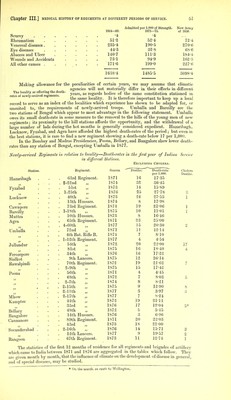
![Admitted per 1,000 of Strength. New Army 1864^9. 1871—75. of 1858. Scurvy ....... 4 4 Rheumatism ...... 51-2 52-4 72-4 Venereal diseases 235-4 190-5 270-6 Eye diseases 44-3 32-8 68-6 Abscess and Ulcer 140-7 111-3 184-4 Wounds and Accidents .... 73-1 94-9 162-3 All other causes 171-6 199-0 227-6 1638-4 1485-5 3098-4 Making' allowance for the peculiarities of certain years^ we may assume that climatic agencies will not materially dilfer in their effects in different The locality as nffecting the death- regards bodies of the same constitution stationed m rates of uewlj-arnved regiments. W i ^■4. t+ ■ +1 f • t j. i i i the same locahty. It is thererore important to keep up a local record to serve as an index of the localities which experience has shown to be adapted for, or unsuited to, the requirements of newly-arrived troops. Umballa and Bareilly are the two stations of Bengal which appear to most advantage in the following statement. Umballa owes its small death-rate in some measure to the removal to the hills of the young men of new regiments; its proximity to the hill stations affords the opportunity, and the withdrawal of a large number of lads during the hot months is generally considered expedient. Hazaribagh, Lucknow, Fyzabad, and Agra have afforded the highest death-rates of the period; but even in the best stations, it is rare to find a new regiment showing a death-rate below 17 per 1,000. In the Bombay and Madras Presidencies, Poona, Bellary, and Bangalore show lower death- rates than any station of Bengal, excepting Umballa in 1877. Newly-arrived Regiments in relation to locality—Death-rates in the first year of Indian Service in different Stations. Excluding Cholera. Station Hazaribagh Fyzabad Lucknow )} Cawnpore Bareilly Muttra Agra jj Umballa >} }> Jullundur j> Ferozepore Sialkot Rawalpindi Poona Mhow Kamptee Bellary Bangalore Cannanore Secunderabad Rangoon Regiment. 63rd 2-22nd 51st 1.25th 40th 13th 73rd 1-18th 10th 65th 4-60th 72nd 4th B 1- 12th 54th 81st 34th 9th 70th 2-9th 56th 68th 2-7th 2- 15th 2-11th 2-17th 44th 33rd 48th 14th 89th 43rd 2-16th 12th 67th Regiment. Hussars. Regiment. Hussars. Retjiment. at. Rifle B. Regiment. Lancers. Regiment. Hussars. Regiment, Lancers. Regiment. Season Deaths. Death-rate per 1,000. 1871 16 17-35 1874 32 86-45 1873 14 15-89 1876 25 27-78 1873 24 27-55 1874 8 17-98 1874 19 21-06 1875 10 11-01 1873 8 16-46 1871 23 25-00 1877 ]5 20-30 1871 11 12-14 1874 7 8-10 1877 4 4-54 1872 20 22-00 1875 16 18-40 1876 16 17-22 1875 12 26-14 1872 19 21-62 1875 15 17-42 1871 4 4-45 1872 7 8-02 1874 8 8-21 1875 9 12-90 1877 3 3-97 1877 7 8-24 1872 19 21-11 1876 17 19-04 1872 5 5-45 1876 3 6-96 1871 20 22-03 1873 18 21-00 1876 14 15-71 1877 9 19-57 1873 11 12-74 Cholera Deaths. 17 4 5-* The statistics of the first 12 months of residence for all regiments and brigades of artillery which came to India between 1871 and 1876 are aggregated in the tables which follow. They are given month by month, that the influence of climate on the development of disease in general, and of special diseases, may be studied. * On the uiaich, en route to Wellingtou,](https://iiif.wellcomecollection.org/image/b24749333_0071.jp2/full/800%2C/0/default.jpg)