Veterinary bacteriology : a treatise on the bacteria, yeasts, molds, and protozoa pathogenic for domestic animals / by Robert Earle Buchanan and Charles Murray.
- Robert Earle Buchanan
- Date:
- 1916
Licence: Public Domain Mark
Credit: Veterinary bacteriology : a treatise on the bacteria, yeasts, molds, and protozoa pathogenic for domestic animals / by Robert Earle Buchanan and Charles Murray. Source: Wellcome Collection.
85/612 page 85
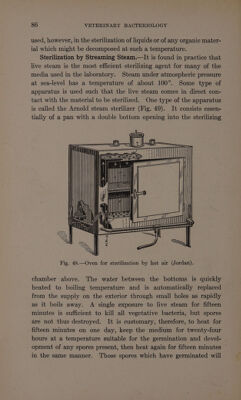
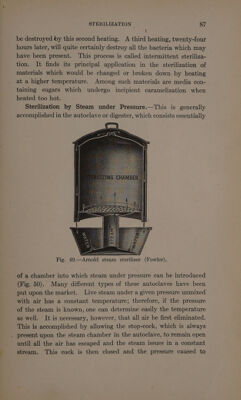
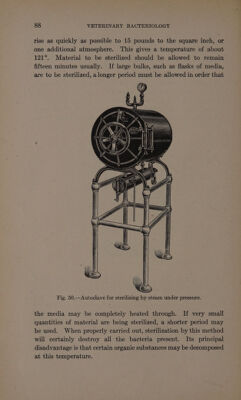
![SECTION, I] LABORATORY METHODS AND TECHNIC CHAPTER VI | STERILIZATION STERILIZATION is the process whereby glassware, media, or any of the materials or apparatus used in the laboratory are entirely freed from living organisms. It is evident that in the study of bacteria it is necessary that we deal with pure cultures, that is, that one kind of organism only be present in the material which we are studying. It is quite impossible to determine from mixed cultures which of the organisms present bring about observed changes. Bacteria are present upon the surface of all laboratory apparatus, in the dust, in soil, upon the hands— they are ubiquitous, hence the necessity for sterilization. Sterilization may be accomplished by physical or chemical means. In practice the latter is generally called disinfection, and is rarely used in the laboratory. The term sterilization, there- fore, as commonly used, indicates the destruction of micro- organisms by physical processes. Sterilization by the Flame.—The platinum wire used in the transfer of bacteria in the laboratory is sterilized by heating to a red or white heat in the flame of the Bunsen burner. Similar methods’ are sometimes used in the sterilization of other small pieces of laboratory apparatus, such as cover-glasses and slides. Sterilization by Hot Air.—Glassware is commonly sterilized by subjecting it to a temperature of 150° to 170° in a hot-air oven for an hour. All bacteria will be destroyed at this tempera- ‘ture providing the material to be sterilized is of a nature such that the heat can penetrate readily to all parts. This method cannot be](https://iiif.wellcomecollection.org/image/b32781386_0085.jp2/full/800%2C/0/default.jpg)
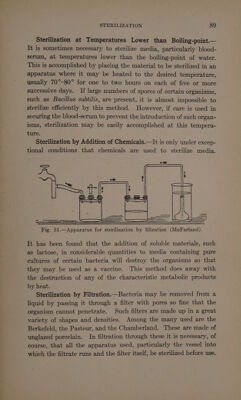
 No text description is available for this image
 No text description is available for this image
 No text description is available for this image