Elements of geology, or, The ancient changes of the earth and its inhabitants as illustrated by geological monuments / by Sir Charles Lyell.
- Charles Lyell
- Date:
- 1865
Licence: Public Domain Mark
Credit: Elements of geology, or, The ancient changes of the earth and its inhabitants as illustrated by geological monuments / by Sir Charles Lyell. Source: Wellcome Collection.
Provider: This material has been provided by King’s College London. The original may be consulted at King’s College London.
37/822 (page 17)
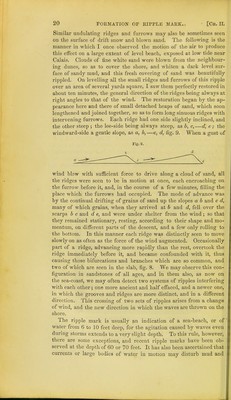
![Cn. II.] CAUSES OF DIAGONAL STRATIFICATION. deviation from parallelism of the slanting laminm cannot possibly be accounted for by any re-arrangement of the particles acquired during the consolidation of the rock. In what manner then can such irre- gularities be due to original deposition ? We must suppose that at the bottom of the sea, as well as in the beds of rivers, the motions of waves, currents, and eddies often cause mud, sand, and gravel to be thrown down in heaps on particular spots instead of being spread out uniformly over a wide area. Sometimes, when banks are thus formed, currents may cut passages through them, just as a river forms its bed. Suppose the bank A (fig. 4.) to be thus formed with Fig.4. £ a steep sloping side, and the water being in a tranquil state, the layer of sediment No. 1. is thrown down upon it, conforming nearly to its surface. Afterwards the other layers, 2, 3, 4, may be deposited in succession, so that the bank B C D is formed. If the current then increases in velocity, it may cut away the upper portion of this mass down to the dotted line e (fig. 4.), and deposit the materials thus removed farther on, so as to form the layers 5, 6, 7, 8. We have now the bank B C D E (fig. 5.), of which the surface is almost level Fig. 5. D E and on which the nearly horizontal layers, 9, 10, 11, may then accumulate. It was shown in fig. 3. that the diagonal layers of suc- cessive strata may sometimes have an opposite slope. This is well ■seen in some cliffs of loose sand on the Suffolk coast. A portion of one of these is represented in fig. 6., where the layers, of which there are about six in the thick- ness of an inch, are composed of quartzose grains. This arrange- ment may have been due to the altered direction of the tides and currents in the same place. The description above given of the slanting position of the minor layers constituting a single stratum is in certain cases applicable on a much grander scale to masses several hundred feet thick, and many miles in extent. A fine example may be seen at the base of the Maritime Alps near Nice. The mountains here terminate abruptly c Fig. 6. Cliffbetween Mismer and Dunwich.](https://iiif.wellcomecollection.org/image/b21309383_0037.jp2/full/800%2C/0/default.jpg)