Elements of geology, or, The ancient changes of the earth and its inhabitants as illustrated by geological monuments / by Sir Charles Lyell.
- Charles Lyell
- Date:
- 1865
Licence: Public Domain Mark
Credit: Elements of geology, or, The ancient changes of the earth and its inhabitants as illustrated by geological monuments / by Sir Charles Lyell. Source: Wellcome Collection.
Provider: This material has been provided by King’s College London. The original may be consulted at King’s College London.
785/822 (page 763)
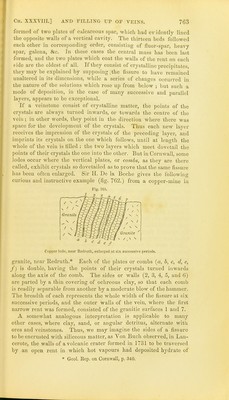
![Cm XXXVIII.] AND FILLING UP OF VEINS. 7G3 formed of two plates of calcareous spar, which had evidently lined the opposite walls of a vertical cavity. The thirteen beds followed each other in corresponding order, consisting of fluor-spar, heavy spar, galena, &c. In these cases the central mass has been last formed, and the two plates which coat the walls of the rent on each side are the oldest of all. If they consist of crystalline precipitates, they may be explained by supposing tthe fissure to have remained unaltered in its dimensions, while a series of changes occurred in the nature of the solutions which rose up from below ; but such a mode of deposition, in the case of many successive and parallel layers, appears to be exceptional. If a veinstone consist of crystalline matter, the points of the crystals are always turned inwards, or towards the centre of the vein ; in other words, they point in the' direction where there was space for the development of the crystals. Thus each new layer receives the impression of the crystals of the preceding layer, and imprints its crystals on the one which follows, until at length the whole of the vein is filled : the two layers which meet dovetail the points of their crystals the one into the other. But in Cornwall, some lodes occur where the vertical plates, or combs, as they are there called, exhibit crystals so dovetailed as to prove that the same fissure has been often enlarged. Sir H. De la Beche gives the following curious and instructive example (fig. 762.) from a copper-mine in Fig. 765. Copper lode, near Redruth, enlarged at six successive periods. granite, near Redruth.* Each of the plates or combs (a, b, c, d, e, f) is double, having the points of their crystals turned inwards aloDg the axis of the comb. The sides or walls (2, 3, 4, 5, and 6) are parted by a thin covering of ochreous clay, so that each comb is readily separable from another by a moderate blow of the hammer. The breadth of each represents the whole width of the fissure at six successive periods, and the outer walls of the vein, where the first narrow rent was formed, consisted of the granitic surfaces 1 and 7. A somewhat analogous interpretation is applicable to mauy other cases, where clay, sand, or angular detritus, alternate witli ores and veinstones. Thus, we may imagine the sides of a fissure to be encrusted with siliceous matter, as Yon Buch observed, in Lau- cerote, the walls of a volcanic crater formed in 1731 to be traversed by an open rent in which hot vapours had deposited hydrate of * Gcol. Rep. on Cornwall, p. 340.](https://iiif.wellcomecollection.org/image/b21309383_0785.jp2/full/800%2C/0/default.jpg)