Elements of geology, or, The ancient changes of the earth and its inhabitants as illustrated by geological monuments / by Sir Charles Lyell.
- Charles Lyell
- Date:
- 1865
Licence: Public Domain Mark
Credit: Elements of geology, or, The ancient changes of the earth and its inhabitants as illustrated by geological monuments / by Sir Charles Lyell. Source: Wellcome Collection.
Provider: This material has been provided by King’s College London. The original may be consulted at King’s College London.
787/822 (page 765)
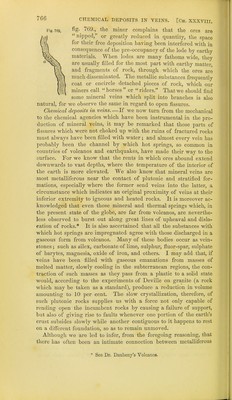
![7G5 Cn. XXXVIII.] CONTRACTION OF VEINS. is a fine example of this in the celebrated vein of Andreasburg in the Hartz, which has been worked for a depth of 500 yards perpen - dicularly, and 200 horizontally, retaining almost every where a ■width of 3 feet. But many lodes in Cornwall and elseAvhere are extremely variable in size, being 1 or 2 inches in one part, and then 8 or 10 feet in another, at the distance of a few fathoms, and then again narrowing as before. Such alternate swelling and contraction is so often characteristic as to require explanation. The Avails of fissures in general, observes Sir H. De la Beche, are rarely perfect planes throughout their entire course, nor could Ave Avell expect them to be so, since they commonly pass through rocks of unequal hardness and different mineral composition. If, therefore, the op- posite sides of such irregular fissures slide upon each other, that is to say, if there be a fault, as in the case of so many mineral veins, the parallelism of the opposite walls is at once entirely destroyed, as Avill be readily seen by studying the annexed diagrams. Fig. 766. Let a b, fig. 766., be a line of fracture traversing a rock, and let a b, fig. 767., represent the same line. Now, if we cut in two apiece of paper representing this line, and then move the lower portion of this cut paper sideAvays from a to a', taking care that the two pieces of paper still touch each other at the points 1, 2, 3, 4, 5, we obtain an irregular aperture at c, and isolated cavities at ddd, and when we compare such figures with nature we find that, with certain modifications, they represent the interior of faults and mineral veins. If, instead of sliding the cut paper to the right hand, we move the lower part towards the left, about the same distance that it was previously slid to the right, we obtain considerable variation in the cavities so produced, two long irregular open spaces, f f fig. 768., being then formed. This Avill serve to shoAv to what slight cir- cumstances considerable variations in the character of the openings between unevenly fractured surfaces may be due, such surfaces being moved upon each other, so as to have numerous points of contact. Most lodes are perpendicular to the horizon, or nearly so; but some of them have a considerable inclination or “ hade,” as it is termed, the angles of dip varying from 15° to 45°. The course of a vein is frequently very straight; but if tortuous, it is found to be choked up Avith clay, stones, and pebbles, at points AA'here it departs most Avidely from vertically. Hence at places, such as a,](https://iiif.wellcomecollection.org/image/b21309383_0787.jp2/full/800%2C/0/default.jpg)