The inscriptions of Piyadasi. Vol. 2, The columnar edicts : the separate edicts, the author and languages of the edicts / by E. Senart ; translated by G.A. Grieson.
- Ashoka
- Date:
- 1892
Licence: Public Domain Mark
Credit: The inscriptions of Piyadasi. Vol. 2, The columnar edicts : the separate edicts, the author and languages of the edicts / by E. Senart ; translated by G.A. Grieson. Source: Wellcome Collection.
12/200 page 4
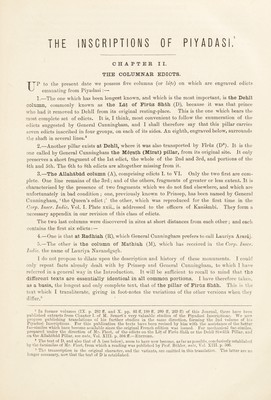
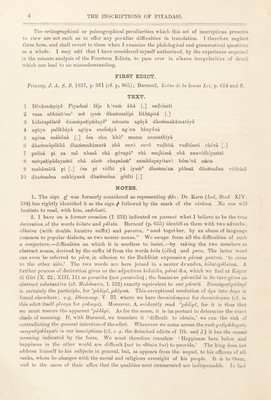
![The orthographical or palæographical peculiarities which this set of inscriptions presents to view are not such as to offer any peculiar difficulties in translation. I therefore neglect them here, and shall revert to them when I examine the philological and grammatical questions as a whole. I may add that I have considered myself authorised, hy the experience acquired in the minute analysis of the Fourteen Edicts, to pass over in silence irregularities of detail which can lead to no misunderstanding. FIRST EDICT. Prinsep, J. A. S. B. 1837, p. 581 (cf. p. 965) ; Burnouf, Lotus de la honne Loi, p. 654 and fi’. TEXT. 1 Dêvânathpiyê Piyadasi lâja hlvaih âhâ [.] sadvîsati 2 vasa abhisitena^ me iyam dhaihmalipi likhâpitâ [.] 3 hidatapâlatô dusariipatipâdayê^ arhnata agâyâ dhaihmakâmatâyâ 4 agâya palîkhâyâ agâya susûsâyâ agèna bhayênâ 5 agêna usâhênâ [.] êsa chu khô® marna anusathiyâ 6 dhammâpêkhâ dhammakâmatâ châ suvê suvê vadhitâ vadhîsati chevâ [.] 7 pulisâ pi ca me ukasâ châ gêvayâ* châ majhimâ châ anuvidhîyamti 8 sarhpatipâdayaihti châ alarîi chapalam® samâdapayitave hêmevâ amta 9 mahâmâtâ pi [•] esa pi vidhi yâ iyam® dhammêna pâlanâ dhariimêna vidhânê 10 dhammêna sukhiyanâ dhammêna gôtîti [.] NOTES. 1, The sign c' was formerly considered as representing dda; Dr. Kern {Ind, Stud. XIV. 394) has rightly identified it as the sign ^ followed by the mark of the virdma. No one will hesitate to read, with him, sadvîsati. 2. I have on a former occasion (I. 232) indicated en 'passant what I believe to be the true derivation of the words liidata and pdlata. Burnouf (p. 655) identifi es them with two adverbs ; idhatra (with doable locative suffix) and paratra, “used together, by an abuse of language common to popular dialects, as two neuter nouns.” We escape from all the difficulties of such a conjecture,—difficulties on which it is needless to insist,—by taking the two members as abstract nouns, derived by the suffix td from the words liida {idha) and para. The latter word can even be referred to para, m. allusion to the Buddhist expression prirai/i gantuih, ‘to cross to the other side.’ The two words are here joined in a neuter dv andva, liidatapdlatarn. A farther process of derivation gives us the adjectives hidatika, paratiha, which we find at Kapur di Griri (X. 22; XIII. II) paratiha {wot paratriha) ; the feminine paratiha in its turn gives an abstract substantive (cf. Mahdvastu, I. 522) exactly equivalent to our pdratd. Busampatipddayê is certainly the participle, for ^pddiye, pddyaih. This exceptional resolution of dya into daya is found elsewhere ; e.g. Dhammap. V. 33, where we have dunnivdrayam iov durnivdryam (cf. in this edict itself gêvaya for grdmya). Moreover, A. evidently read °pddiyê, for it is thus that we must restore the apparent °pdddyê. As for the sense, it is im portant to determine the exact shade of meaning. If, with Burnouf, we translate it ‘difficult to obtain,’ we run the risk of contradicting the general intention of the edict. Whenever we come across the yerhpatipddayati. sampatipddayati in our inscriptions (cf, e. g. the detached edicts of Dh. and J.) it has the causal meaning indicated by the form. We must therefore translate ‘Happiness here below and happiness in the other world are difficult (not to obtain hut) to provide.’ The king does not address himself to his subjects in general, but, as appears from the sequel, to his officers of all ranks, whom he charges with the moral and religious oversight of his people. It is to them, and to the cares of their office that the qualities next enumerated are indispensable. In fact](https://iiif.wellcomecollection.org/image/b29353178_0012.jp2/full/800%2C/0/default.jpg)

 No text description is available for this image
 No text description is available for this image
 No text description is available for this image