The inscriptions of Piyadasi. Vol. 2, The columnar edicts : the separate edicts, the author and languages of the edicts / by E. Senart ; translated by G.A. Grieson.
- Ashoka
- Date:
- 1892
Licence: Public Domain Mark
Credit: The inscriptions of Piyadasi. Vol. 2, The columnar edicts : the separate edicts, the author and languages of the edicts / by E. Senart ; translated by G.A. Grieson. Source: Wellcome Collection.
13/200 page 5
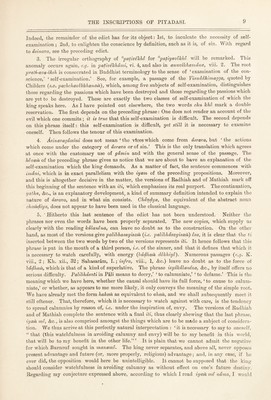
![this interpretation exactly agrees with the thought and intention manifested at the end of the Vlth (rock) edict, in very analogous terms, and it will be recognised that the conditions indicated, ^anksha ‘ alertness in oversight,’ bJimja, ‘ fear’ of the king (cf. edict VIII. below) apply infinitely better to the officials in question, than to subjects in general. 3. The phrase chu Itlib does not indicate, as Burnouf thought, a consequence, ‘also, for.’ It indicates, as is shewn by the evidence of the synonym tu hho (e.g. G. IX. 5, 7) and the varions passages where it is employed (e.g. G. IX. 8, 3, below VIII. 9, &c.), a slight opposition, ‘but, now.’ The conditions of which the king speaks are necessary and difficult to find ; hut, thanks to his instructions, they develop from day to day. It is necessary to read anusathiya as one word, as an instrumental. With regard to the use of suve suve in the meaning of ‘ every day,’ ‘from, day to day,’ cf. Dhammap. V. 229. 4. Burnouf’s identification of gêvayâ with grâmyâ, appears to me as certain as it is ingenious. The neighbourhood of the epithets uhasci and majliimd proves that the word should be taken not in its etymological, but in its secondary sense of ‘ low, inferior, lowest.’ Analogous examples will be found in the dictionaries, and I add the passage of the Lai. Vist, (540,10), where grarnya is, in this sense, placed between liina and pdrthagjaniha. Regarding anuvidMyamti, cf. I. 232. 5. There can be no question of dividing the sentence before alam, nor is it necessary to change samddapayitave, as proposed by Burnouf. Samdda^eti is in Buddhist language used in the sense of ‘ to convert ;’ the infinitive is governed by alam, and the whole phrase forms a development explanatory of sampatipddayarhti. From the well-established use of this verb, it follows that chapalam cannot be taken as an abstract neuter. It must designate collectively men who are thoughtless, easily lead away (cf. Dhammap. V. 33 ; chapalam chittam). It is possible that anuvidMyamti and sarhpatipadayamti have as an object anusatliim, understood from the anusathiyd of the preceding sentence ; but we shall see below, especially in the detached edicts of Dhauli and of Jaugada, sampaiipddayaii ot patipddayati employed absolutely; so also we shall find the phrase dhammdnupatipattim anupatipajati (below, VIII. 3), but more usually paiipajati or sampatipajati used absolutely. Hence, the translations ‘ to be, to walk in the good way,’ and for the causal, ‘ to place, to cause to ’walk in the good way’ appear to me to be those which best render the exact meaning of the verb. As regards hêmêvd, i.e. evam êva, which we meet subsequently in other edicts and also in the detached edicts of Dh. and J., cf. Hemachandra, Ed. Pischel, I. 271. The parallel versions prohibit us from supposing, with Burnouf, that anything is missing from the end of the line, to be completed as amta pmaso] ; moreover this word would not suit the sense. The text is certainly complete here, but this certainty does not relieve us of any difficulty. If we consider the reading as entirely correct, we must consider amtamahdmdtd as a compound signifying officials stationed at the frontiers ; and, as a matter of fact, the Vth of the Fourteen Edicts tells us of mahdmdtras charged with the duty of watching the border-populations. It is also natural that Piyadasi, always intent on extending his charitable cares beyond his own kingdom, should expressly mention, after the officials of all ranks of the interior, those whose actions extended beyond (cf. Dh. Ilnd det. ed.). Nevertheless, I have some doubts about this. The Xllth edict speaks positively of mahdmdtras charged with the oversight of women, and, according to the Vth, the dharmamahdmdiras had to busy themselves with the domestic affairs of all the members of the royal family. If we only changed arkta into amtt, and the correction is an easy one, we should find an allusion to these ‘ domestic officials.’ The agreement of all the versions in reading ta nevertheless compels me to decide in favour of the first interpretation. 6. The phrase yd iyam occurs again in the Vlllth edict, 1. 7, in the same meaning, i. e. as equivalent to the Pali phrase fdmk ‘to wit.’ Although iyam is often employed in oar inscriptions as a neuter, I do not think that we are obliged to take yd iyam as actually identical with y ad idam. In the two places where it occurs, the first substantive which follows the](https://iiif.wellcomecollection.org/image/b29353178_0013.jp2/full/800%2C/0/default.jpg)
 No text description is available for this image
 No text description is available for this image
 No text description is available for this image