Volume 1
A text-book of the theory and practice of medicine / by American teachers ; edited by William Pepper.
- Date:
- 1893-1894
Licence: Public Domain Mark
Credit: A text-book of the theory and practice of medicine / by American teachers ; edited by William Pepper. Source: Wellcome Collection.
873/962 (page 853)
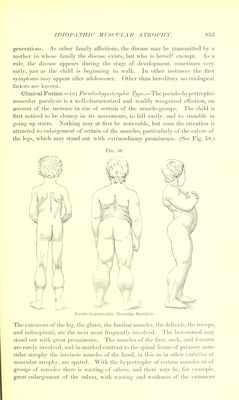
![generations. As other family affections, the disease may be transmitted by a mother in whose family the disease exists, but who is herself exempt. As a rule, the disease appears during the stage of development, sometimes very early, just as the child is beginning to walk. In other instances the first symptoms may appear after adolescence. Other than hereditary no etiological factors are known. Clinical Forms.—(«) Pseudo-hi/perirophic Type.—The ]>seutlo-liypertrophic muscular paralysis is a well-characterized and readily recognized affection, on account of the increase in size of certain of the muscle-groups. The child is first noticed to be clumsy in its movements, to fall easily, and to stumble in going up stairs. Nothing may at first be noticeable, but soon the attention is attracted to enlargement of certain of the muscles, 2)articuiarly of the calves of the legs, which may stand out with extraordinary prominence. (See Fig. 58.) Fig. 58. Pseudo-hvpcrtrophic Muscular Paralysis. The extensors of the leg, the glutei, the lumbar nuisclcs, the deltoids, the triceps, and infraspinati, are the next most frequently involved. The last-named may stand out with great prominence. The nniscles of the face, neck, and forearm are rarely involved, and in marked contrast to the spinal forms of primai'v nuis- cular atrophy the intrinsic muscles of the hand, in this as in other varieties of muscular atro])liy, arc spared. With the hypertrophy of certain muscles or of groups of muscles there is wasting of othei's, and there may be, for example, great enlargement of the calves, with wasting and weakness of the extensors](https://iiif.wellcomecollection.org/image/b20413920_001_0873.jp2/full/800%2C/0/default.jpg)