Volume 1
A text-book of the theory and practice of medicine / by American teachers ; edited by William Pepper.
- Date:
- 1893-1894
Licence: Public Domain Mark
Credit: A text-book of the theory and practice of medicine / by American teachers ; edited by William Pepper. Source: Wellcome Collection.
875/962 (page 855)
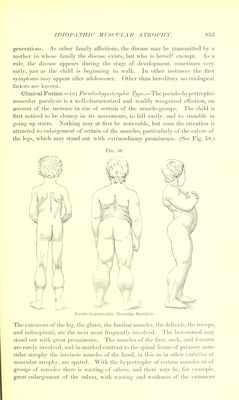
![pletely closed. The luiiscles of the slioulder-girdle waste and the larger muscles of the thighs. Erb calls attention to tlie vahiable test of the strength of the shoulder-girdle muscles in lifting the child bv the arm-pits, when in weakness of tliese groups no resistance is offered and the shoulders are forced up almost to the child's ears. Intermediate forms and types are met with, but tio not, however, need special description. In all forms the onset of tl)e disease is gradual, and the wasting and weak- ness produced simultaneously in the various muscle-groups already men- tioned. A striking feature is the al)sence of wasting in the intrinsic muscles of the hands—a contrast to the s])inal form of muscular atrojihy. The muscles of the tongue, ])liarynx, larynx, a)id eye are not affected. In all varieties the electrical irritability of the muscles is lessened in direct propor- tion to the wasting. There is no reaction of degeneration. Fibrillary twitch- ing is rarely present. The sensation is luiimpaired. The reflexes are weak ; in the later stages lost, never increased. The sphincters are not invfilved. Late in the disease deformities occur, such as cui'vature of the spine and various forms of talipes. The disease persists for an indefinite ])eriod, and it may be many years before the ]iatient is bed-ridden. Morbid Anatomy.—The spinal cord and ]icri])lici-al nerves have l)een found normal, but Erb thinks that there are certain features which point to central dynamic clianges as the cause of the atrophy, such as heredity, the special localization, and the existence occasionally of associated disorders of the brain, such as idiocy and epilepsy. In the pseudo-hypertrophic form tlie muscle-fibres present great variations in size. In the early stage there may be marked ehlargement and the nuclei of the sarcolemma are increased. The fibres have sometimes been seen to be fissured longitudinally. The enlarge- ment is chiefly due to the increase in the connective tissue and fat. In- which in the later stages the muscle mav be largely re])Iaced. In the pi'imarv atrophic form a similar enlargement of the muhcle-fil)rcs has been nnticcd. The increase in the interstitial tissue is not so striking. The wasting of the fil)res and the replacement by connective tissue and fat seem to be gradual processes. Diagnosis.—The psendo-hy]K'rtrophic form is recognizable at a glance. The striking contrast between the athletic appearance and the fecltle condition, the attitude, gait, and mode of rising from the floor, uiakc up an unmistakable symptom-group. It is to be remembered, liowcvcr, that the gait and the mode of rising may bo quite as characteristic of the sim|)le atrophic forms. The occurrence in family groups is also a jxiint of great importance. From myelopathic or sjiinal muscular atrophy the forms arc usually easily separated. In the atrophy of chronic poliomyelitis anterior the small muscles of the hand are, as a rule, first attacked, whereas in the ])rimary myopatliies the muscles of the calves or of the shoulder-girdle or of the thighs are first involved. In spinal atroj)liy the reaction of degeueration is present and fibrillary tW'itch-](https://iiif.wellcomecollection.org/image/b20413920_001_0875.jp2/full/800%2C/0/default.jpg)