A pharmaceutical guide : in two parts ... / By the author of The student's manual ... [i.e. Richard Harrison Black].
- Black, R. Harrison (Richard Harrison)
- Date:
- 1822
Licence: Public Domain Mark
Credit: A pharmaceutical guide : in two parts ... / By the author of The student's manual ... [i.e. Richard Harrison Black]. Source: Wellcome Collection.
186/188 (page 90)
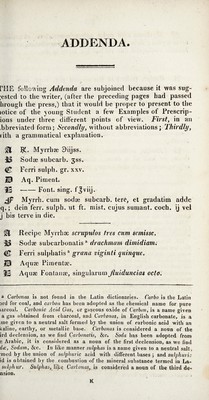
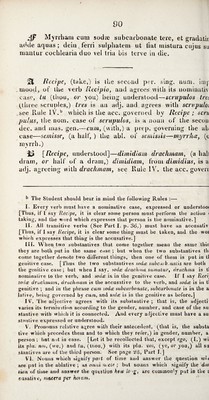
![/ 4? Myrrham cum sodae subcarbonate tere, et gradatir adde aquas; dein ferri sulphatem ut liat mistura cujus su luantur cochlearia duo vel tria bis terve in die. Recipe, (take,) is the second per. sing. num. imp .mood, of the verb Recipio, and agrees with its uominativ case, in (thou, or you) being understood—scrupulos tret (three scruples,) Ires is an adj. and agrees with scrupula .see Rule IV.b which is the acc. governed by Recipe ; sen pul us, the nom. case of scrupulos, is a noun of the secon dec. and mas. gen.—cum, (with,) a prep, governing the ah ease—6emisse, (a half, ) the abi. of semissis—myrrhee, (c myrrh.) 'j& [Recipe, understood]—dimidiam drachmam, (a hall dram, or half of a dram,) dimidiam, from dimidius, is a adj. agreeing with drachmam, see Rule IV. the acc.goveri The Student should bear in mind the following Rules :— I. Every verb must have a nominative case, expressed or understoo< [Thus, if l say Recipe, it is clear some person must perform the action < taking, and the word which expresses that person is the nominative.] II. All transitive verbs (See Part I. p. 36,) must have an accusativ [Thus, if I say Recipe, it is clear some thing must be taken, and the woi which expresses that thing is the accusative.] IU. When two substantives that come together mean the same thin they are both put in the same e^se ; but when the two substantives th come together denote two different things, then one of them is put in tl genitive case. [ Thus the two substantives soda subcat b.nalis are both the genitive case; but when I say, soda drachma samatur, drachma is tl nominative to the verb, and soda is in the genitive case. If l say Reci1 soda drachmam, drachmam is the accusative to the verb, and soda is in tl genitive ; and in the phrase cum soda subcarbonate, subcarbonate is in the a lative, being governed by cum, and soda is in the genitive as before.] IV. The adjective agrees with its substantive; that is, the adjecti varies its termination according to the gender, number, and case of the su stantive with which it is connected. And every adjective must have a su stantive expressed or understood. V. Pronouns relative agree with their antecedent, (that is, the substa tive which precedes them and to which they refer,) in gender, number, a person ; bat nut in case. [Let it be recollected that, except ego, (I.) wi its pin. nos, (we,) and tu, (tnou,) with its plu. vos, (ye, or you,) all su stantives are of the third person. See page 28, Part I.] VI. Nouns which signify part of time and answer the question tola are pat in the ablative ; as omni m.cte ; but nouns which signify the dm tion of time and answer the question hew lo >g, are commonly pat in the £ «usalive, maeera per horam.](https://iiif.wellcomecollection.org/image/b30796374_0186.jp2/full/800%2C/0/default.jpg)