Licence: Public Domain Mark
Credit: On brecciated concretions / by John Ruskin. Source: Wellcome Collection.
Provider: This material has been provided by The Royal College of Surgeons of England. The original may be consulted at The Royal College of Surgeons of England.
5/12
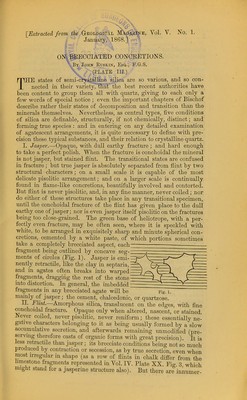
![\v\ fExtracted from the Geological Magazine, Yol. V. No. 1. January, 1868.] ON BRECCIATED CONCRETIONS. V. By John Buskin, Esq., F.G.S. (PLATE III.) THE states of semi-crystalline silica are so various, and so con- nected in their variety, that the best recent authorities have been content to group them all with quartz, giving to each only a few words of special notice ; even the important chapters of Bischof describe rather their states of decomposition and transition than the minerals themselves. Nevertheless, as central types, five conditions of silica are definable, structurally, if not chemically, distinct; and forming true species : and in entering on any detailed examination of agatescent arrangements, it is quite necessary to define with pre- cision these typical substances, and their relation to crystalline quartz. I. Jasper.—Opaque, with dull earthy fracture ; and hard enough to take a perfect polish. When the fracture is conchoidal the mineral is not jasper, but stained flint. The transitional states are confused in fracture; but true jasper is absolutely separated from flint by two structural characters; on a small scale it is capable of the most delicate pisolitic arrangement; and on a larger scale is continually found in flame-like concretions, beautifully involved and contorted. But flint is never pisolitic, and, in any fine manner, never coiled; nor do either of these structures take place in any transitional specimen, until the conchoidal fracture of the flint has given place to the dull earthy one of jasper; nor is even jasper itself pisolitic on the fractures being too close-grained. The green base of heliotrope, with a per- fectly even fracture, may be often seen, where it is speckled with white, to be arranged in exquisitely sharp and minute spherical con- cretions, cemented by a white paste, of which portions sometimes take a completely brecciated aspect, each fragment being outlined by concave seg- ments of circles (Fig. 1). Jasper is emi- nently retractile, like the clay in septaria, and in agates often breaks into warped fragments, dragging the rest of the stone into distortion. In general, the imbedded fragments in any brecciated agate will be mainly of jasper; the cement, chalcedonic, or quartzose. II. Flint.—Amorphous silica, translucent on the edges, with fine conchoidal fracture. Opaque only when altered, nascent, or stained. Never coiled, never pisolitic, never reniform; these essentially ne- gative characters belonging to it as being usually formed by a slow accumulative secretion, and afterwards remaining unmodified (pre- serving therefore casts of organic forms with great precision). It is less retractile than jasper; its brecciate conditions being not so much produced by contraction or secession, as by true secretion, even when most irregular in shape (as a row of flints in chalk differ from the limestone fragments represented in Vol. IV. Plate XX. Fig. 3 which might stand for a jasperine structure also). But there are innumer-](https://iiif.wellcomecollection.org/image/b22395532_0007.jp2/full/800%2C/0/default.jpg)