A short manual of analytical chemistry : qualitative and quantitative inorganic and organic arranged on the principle of the course of instruction given at the South London Central Public Laboratory and the South London School of Pharmacy / by John Muter.
- Muter, John, 1841-1912.
- Date:
- 1887
Licence: Public Domain Mark
Credit: A short manual of analytical chemistry : qualitative and quantitative inorganic and organic arranged on the principle of the course of instruction given at the South London Central Public Laboratory and the South London School of Pharmacy / by John Muter. Source: Wellcome Collection.
211/220 page 193
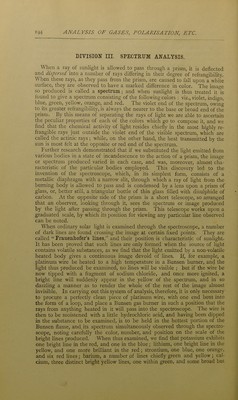
![original plane. Such substances are said to possess the power of circular polarisation, either in a “right-handed” or “left-handed” direction, accord- ing as it is necessary to turn the prism either to the right or left from its proper position to once more produce complete passage of the colorless polarised ray. The direction of the rotation is indicated by the use of arrows, thus: <?*c. Cane sugar, grape sugar, dextrin, maltose, creasote, camphor, tartaric acid, cinchonine, castor oil, croton oil and oil of lemons rotate the plane of the polarised ray to the right; while fruit, or invert-sugar, quinine, cinchonidine, turpentine, and many essential oils, morphine, etc., have a left-handed rotation. There are two varieties of quartz, known as right-handed and left-handed, one of which rotates the plane of polarisation to the right and the other to the left. If a plate of quartz 1 millimetre thick be placed between the two “Nicols,” the ray of polarised light is rotated, and instead of being colorless, is colored, changing to all the colors of the spectrum as the analyser is turned, until it once more becomes colorless, and the amount that the analyser has to be turned (registered by a pointer on the degrees of the circle) is the index of rotary polarisation possessed by the quartz either in a right- or left-handed direction. If the turning of the analyser be now continued, color will again show itself, but this time it will be the color complementary to that at first produced. Thus, if we start with a. plate of quartz showing red between the uncrossed prisms, and rotate, we shall find that when we have turned through an angle of 45°, we get no color, but after that we begin to get the com- plementary color green, which becomes most intense at the right angle of go°, when the prisms are crossed. The polariscope as used for analysis is therefore essentially (a) a Nicol’s prism acting as a polariser, {b) ;a plate of quartz usually divided down the centre, the one side being right-handed and the other left, {c) a tube to contain the solution, (d) another “Nicol” capable of being rotated, and having a pointer acting on degrees of the circle on a scale, (e) a telescope to focus the line between the two sides of the quartz. When the pointer is placed at zero, the tube filled with water and the line focussed, no color is seen on either side of it, but if a solution say of sugar be intro- duced, then color appears on one side of the line according to the nature of the sugar, and then the distance through which the pointer has to be moved round the graduated circle to get both sides of the quartz colorless is the degree of rotary polarisation. In practice monochromatic light from a sodium flame is employed, and this, destroying all color, causes a dark shadow instead of a color to appear when the instrument is used, so enabling color-blind persons to employ it without difficulty. To use the instrument we make a solution of the body to be examined of a definite percentage strength by dis- solving a certain number of grammes in 100 c.c. of a solvent. We then fill the tube, observe the degree of rotation produced, and from that we calculate the absolute angle of rotation for the sodium light (always expressed as [a]) as follows:— Let a=the observed angle, c the strength in grammes per xoo c.c., and / the length of the tube used in decimetres ; then— [«]d — 100a c x l If the absolute angle thus found coincides with that obtained from the same substance in a state of purity, then the article under examination is pure, but if not, then a simple per- centage calculation gives the impurity. Thus the [a]D of pure cane sugar = . A sample examined as above gave an (VJD = . Then : - = per cent, of real sugar present in the sample.](https://iiif.wellcomecollection.org/image/b28109338_0211.jp2/full/800%2C/0/default.jpg)