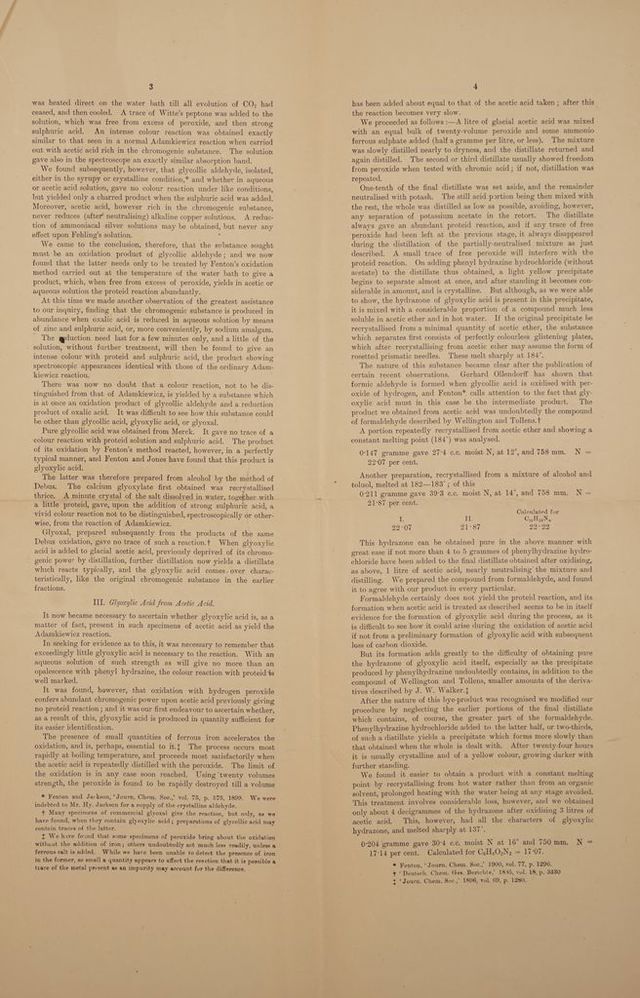
On the proteid reaction of Adamkiewicz : with contributions to the chemistry of glyoxylic acid / by F. Gowland Hopkins and Sydney W. Cole.
- Frederick Hopkins
- Date:
- [1901]
Licence: Public Domain Mark
Credit: On the proteid reaction of Adamkiewicz : with contributions to the chemistry of glyoxylic acid / by F. Gowland Hopkins and Sydney W. Cole. Source: Wellcome Collection.
1/6
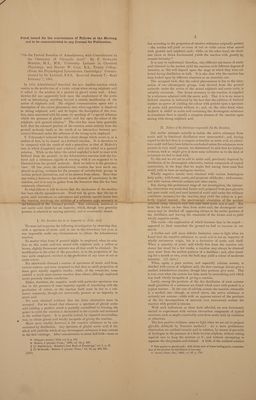
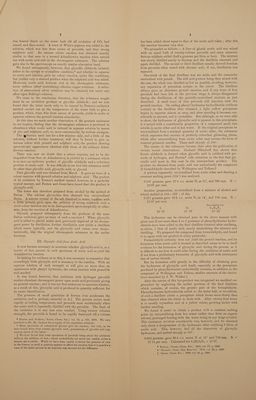
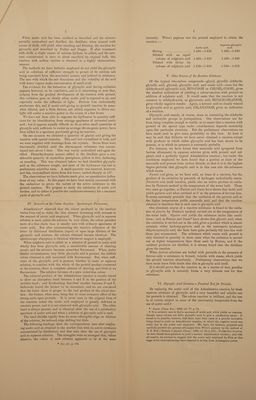
![Proof, issued for the convenience of Fellows at the Meeting, not to be communicated to any Journal for Publication. “On the Proteid Reaction of Adamkiewicz, with Contributions to the Chemistry of Glyoxylie Acid” By F. Gownanp Hopkins, M.A., M.B., University Lecturer in Chemical Physiology, and SypNry W. Coin, B.A., Trinity College. (From the Physiological Laboratories, Cambridge.) Commu- nicated by Dr. Lancuey, F.R.S. Received January 7,—Read February 7, 1901. In 1874 Adamkiewicz* described the now familiar reaction which results in the production of a violet colour when strong sulphuric acid is added to the solution of a proteid in glacial acetic acid. Adam- kiewicz did not apparently look upon the employment of the acetic acid as introducing anything beyond a certain modification of the action of sulphuric acid. His original communication opens with a description of the colour phenomena seen when egg-white is dissolved in strong sulphuric acid; and he begins the description of this reac- tion, since associated with his name, by speaking of “a special influence which the presence of glacial acetic acid has upon the colour of the sulphuric acid proteid solution.” The view has since been generally held that the coloured product of the reaction arises entirely from the proteid molecule itself, as the result of an interaction between pre- cursors liberated under the influence of the strong acids employed. V. Udranszkyt believed that the colour change which occurs is, as a matter of fact, to be classed as a furfurol reaction. It is therefore to be compared with the result of such a procedure as that of Molisch’s test, in which Bnaphthol and sulphuric acid are added to a proteid solution. While in the latter the added naphthol is held to react with furfurol from the proteid ; in the Adamkiewicz reaction both the fur- furol and a substance capable of reacting with it are supposed to be liberated from the proteid molecule. Such we believe is the prevalent view. Of late years, the Adamkiewicz reaction has been much em- ployed as giving evidence for the presence of carbohydrate groups in certain proteid derivatives, and of its absence from others. More than one writer,t however, has referred to an element of uncertainty in the reaction, and it is easy to gather from the literature that this has been commonly observed.§ In what follows it will be shown that the mechanism of the reaction has been wholly misunderstood. Proof will be given that the use of acetic acid introduces an extraneous and perfectly spec ific factor into not acetic acid itself but an impurity, which, though yery generally present, is admixed in varying quantity, and is occasionally absent. ] I. The Reaction due to an Impurity in Acetic Acid, We were led to pursue the following investigation by observing that, with a specimen of acetic acid in use in this laboratory last year, it was impossible under any circumstances to obtain the Adamkiewicz reaction. No matter what form of proteid might be employed, when its solu- tion in this acetic acid was mixed with sulphuric acid, a yellow or brown, slightly fluorescent mixture was all that could be obtained. No modification in the order of the procedure, or in the proportion of the two acids employed, resulted in the production of any trace of red or violet colour. We afterwards obtained a number of specimens of acetic acid from various makers, and were surprised to find that no small proportion of these gave equally negative results ; while, of the remainder, some yielded a much more intense reaction than others, although employed under precisely similar conditions. Hither, therefore, the negative result with particular specimens was due to the presence of some impurity capable of interfering with the production of colour, or the reaction itself must be due to a sub- stance commonly, though not universally, present as an impurity in acetic acid. We soon obtained evidence that the latter alternative must be accepted. For we found that whenever a specimen of glacial acetic acid yielding a positive result is partially crystallised by freezing, the power to yield the reaction is diminished in the crystals and increased in the mother liquor. It is possible indeed, hy repeated recrystallisa- tion, to obtain glacial acid wholly incapable of giving the reaction. Much more readily, however, is the reactive substance to be con- centrated by distillation. Any specimen of glacial acetic acid, if dis- tilled, will yield the whole of any ahnbmienento, substance it may contain in the first runnings. After concentration to about half-bulk—more or * ‘Pfliiger’s Archiv,’ 1874, vol. 9, p. 156. + ‘ Zeitsch. f. physiol. Chem.,’ 1888, vol 12, p. 395. t Cf. Halliburton, ‘ Schiifer's Text Book of Physiology,’ vol. 1, p. 47. § Cf. Sa’kowski, ‘Zeitsch. f. physiol. Chem.,’ vol. 12, pp. 220, 222. 2 less according to the proportion of reactive substance originally present —the residue will yield no trace of red or violet colour when mixed with proteid and sulphuric acid; while, on the other hand, the distil- late twice or thrice fractionated yields the reaction with greatly in- creased intensity.* It is easy to understand, therefore, why different specimens of acetic acid obtained in the market yield the reaction with different degrees of intensity, as this will depend upon the stage at which they were col- lected during distillation in bulk. It is also clear why the reaction has been looked upon by different observers as an uncertain one. The accepted view, that the colour phenomenon is due to the inter- action of two chromogenic groups, both derived from the proteid molecule under the action of the mixed sulphuric and acetic acids, is certainly erroneous. One factor necessary to the reaction is supplied by a substance admixed with the acetic acid. That it is in no sense a furfurol reaction is indicated by the fact that the addition of furfurol confers no power of yielding the colour with proteid upon a specimen of acetic acid previously without it; and, on the other hand, when furfurol is added to acetic acid containing the chromogenic substance in abundance there is equally a complete absence of the reaction upon mixing with strong sulphuric acid. Il. Nature of the Substance responsible for the Reaction. Our earlier attempts actually to isolate the active substance from acetic acid by fractional distillation were unsuccessful ; and, having regard to the fact that, in a reagent so familiar as acetic acid, no adam ture could well have been hitherto overlooked unless the substances were present in very small amount, we determined to seek first for indirect evidence, such as might give at least some indication as to the kind of substance we had to deal with. To this end we set out to add to acetic acid, previously deprived by distillation of its chromogenic admixture, various compounds of typical constitution, in the hope that we might find among these some that would yield at least an analogous reaction. Wholly negative results were obtained with various homologous fatty acids ; with formic, acetic, and propionic aldehydes ; with acetone, and with various ethereal acetates and other esters. But, during this preliminary stage of our investigation, the interest- ing observation was made that formic acid, prepared from pure glycerin and pure oxalic acid, and used instead of acetic acid under the ordinary conditions necessary for the reaction, may yield the colour in a per- fectly typical manner; the spectroscopic absorption of the product from the formic no less than from acetic acid, the chromogenic sub- stance may be distilled off, appearing always in the earlier portions of the distillates, and leaving the remainder of the formic acid to yield wholly negative results. This result—the explanation of which becomes clear in the sequel— appeared to limit somewhat the ground we had to traverse in our search, A further and still more definite limitation came to light when we found that the reactive substance in acetic acid is not an impurity of wholly extraneous origin, but is a derivative of acetic acid itself. When a quantity of acetic acid wholly free from the reactive sub- stance has stood for a few weeks, a reaction may always be obtained once more from the earliest portions of a distillate ; and, after stand- ing for a month or two, even the bulk may yield a colour of moderate intensity. (Cf. infra.) When, again, a pure acetate, and especially calcium acetate, is distilled with excess of sulphuric acid, the first rannings always give a marked Adamkiewicz reaction, though later portions give none. This is true even when the acetate has been made by neutralising acid which was itself wholly incapable of giving a reaction. Lastly, among the products of the dry distillation of most acetates small quantities of a substance are found which react with proteid in a typical manner. In the case of calcium acetate the reaction obtainable is a marked one—though, as stated above, the active substance is certainly not acetone—while with an aqueous extract of the products of the dry decomposition of mercuric (not mercurous) acetate the reaction with proteid is intense. With such indications as these facts afforded, we now fortunately elected to experiment with various two-carbon compounds of typical structure, such as might conceivably arise from acetic acid, by oxidation or otherwise. ’ The first positive evidence came to light when we set out to prepare glycollic aldehyde by Fenton’s method.t As a mere preliminary observation, we oxidised tartaric acid in solution, by means of peroxide of hydrogen in the presence of a little ferrous sulphate, without taking especial care to keep the mixture at 0°, and without attempting to separate the dioxymaleic acid formed. A little of the oxidised solution * This applies to glacial acid ; with dilute acid of lower boiling point, concentra- tion of the product by distillation is less easy.](https://iiif.wellcomecollection.org/image/b33427884_0001.jp2/full/800%2C/0/default.jpg)