[Report 1963] / Medical Officer of Health, Portsmouth Borough.
- Portsmouth (England). Borough Council.
- Date:
- 1963
Licence: Attribution 4.0 International (CC BY 4.0)
Credit: [Report 1963] / Medical Officer of Health, Portsmouth Borough. Source: Wellcome Collection.
49/138 (page 47)
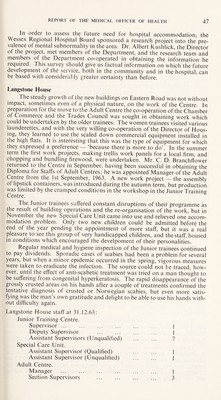
![In order to assess the future need for hospital accommodation, the Wessex Regional Hospital Board sponsored a research project into the pre¬ valence of mental subnormality in the area. Dr. Albert Kushlick, the Director of the project, met members of the Department, and the research team and members of the Department co-operated in obtaining the information he required. This survey should give us factual information on which the future development of the service, both in the community and in the hospital, can be based with considerably greater certainty than before. Langstone House The steady growth of the new buildings on Eastern Road was not without impact, sometimes even of a physical nature, on the work of the Centre. In preparation for the move to the Adult Centre the co-operation of the Chamber of Commerce and the Trades Council was sought in obtaining work which could be undertaken by the older trainees. The women trainees visited various launderettes, and with the very willing co-operation of the Director of Hous¬ ing, they learned to use the scaled down commercial equipment installed in the high flats. It is interesting that this was the type of equipment for which they expressed a preference — ‘because there is more to do’. In the summer term the first work projects, making trellis work panels for a local firm, and chopping and bundling firewood, were undertaken. Mr. C. D. Branchflower returned to the Centre in September, having been successful in obtaining the Diploma for Staffs of Adult Centres; he was appointed Manager of the Adult Centre from the 1st September, 1963. A new work project — the assembly of lipstick containers, was introduced during the autumn term, but production was limited by the cramped conditions in the workshop in the Junior Training Centre. The Junior trainees suffered constant disruptions of their programme as the result of building operations and the re-organisation of the work, but in November the new Special Care Unit came into use and relieved one accom¬ modation problem. Only two new children could be admitted before the end of the year pending the appointment of more staff, but it was a real pleasure to see this group of very handicapped children, and the staff, housed in conditions which encouraged the develpoment of their personalities. Regular medical and hygiene inspection of the Junior trainees continued to pay dividends. Sporadic cases of scabies had been a problem for several years, but when a minor epidemic occurred in the spring, vigorous measures were taken to eradicate the infection. The source could not be traced, how¬ ever, until the effect of anti-scabetic treatment was tried on a man thought to be suffering from congenital hyperkeratosis. The rapid disappearance of the grossly crusted areas on his hands after a couple of treatments confirmed the tentative diagnosis of crusted or Norwegian scabies, but even more satis¬ fying was the man’s own gratitude and delight to be able to use his hands with¬ out difficulty again. Langstone House staff at 31.12.63: Junior Training Centre. Supervisor ... ... ... ... ... ... j Deputy Supervisor ... ... ... ... ] Assistant Supervisors (Unqualified) ... ... 7 Special Care Unit. Assistant Supervisor (Qualified) . 1 Assistant Supervisor (Unqualified) . ] Adult Centre. Manager . ... l Section Supervisors ,,, 3](https://iiif.wellcomecollection.org/image/b29995942_0049.jp2/full/800%2C/0/default.jpg)