A collection of papers which passed between the late learned Mr. Leibnitz and Dr. Clarke in the years 1715 and 1716 relating to the principles of natural philosophy and religion / [In French and English] With an appendix. To which are added letters to Dr. Clarke concerning liberty and necessity; from a gentleman of the University of Cambridge [J. Bulkeley]: with the Doctor's answers to them. Also remarks upon a book entituled A philosophical enquiry concerning human liberty [by A. Collins] By Samuel Clarke.
- Samuel Clarke
- Date:
- 1717
Licence: Public Domain Mark
Credit: A collection of papers which passed between the late learned Mr. Leibnitz and Dr. Clarke in the years 1715 and 1716 relating to the principles of natural philosophy and religion / [In French and English] With an appendix. To which are added letters to Dr. Clarke concerning liberty and necessity; from a gentleman of the University of Cambridge [J. Bulkeley]: with the Doctor's answers to them. Also remarks upon a book entituled A philosophical enquiry concerning human liberty [by A. Collins] By Samuel Clarke. Source: Wellcome Collection.
474/490 page 38
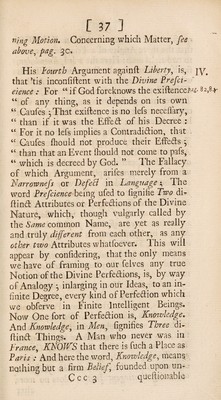
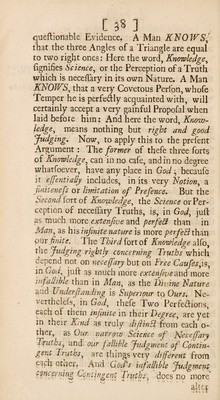
![.... E 3» ] queftiotiable Evidence, A Man KNOWS, that the three Angles of a Triangle are equal to two right ones: Here the word. Knowledge, fignifies Science, or the Perception of a Truth which is neceflary in its own Nature, A Man KNOWS, that a very Covetous Perfon, whofe Temper he is perfeftly acquainted with, will certainly accept a very gainful Propofal when laid before him: And here the word. Know¬ ledge y means nothing but right and good Judging. Now, to apply this to the prefent Argument : The former of thefe three forts of Knowledge, can in no cafe, and in no degree whatfoever, have any place in God • becaufe it effentially includes, in its very Notion, a finhenefs or Imitation of Prefence. But the Second fort of Knowledge, the Science or Per¬ ception of necelTary Truths, is, in God, juft as much more extenfive and perfeB than in Man, as his infinite nature is more perfeB than pur finite. The Third fort of Knowledge alfo, rue fudging rightly concerning Truths which depend not on neçeffary but on Tree Caufes,is, in God, juft as much more extenfive and more infallible than in Man, as the Divine Nature and T nder/landing is Supérieur to Ours• Ne» verthelefs, in God, thefe Two Perfections, each of them infinite in their Degree, are yet in their Kind as truly diftinSl from each o- ther, as Our narrow Science of Ne ce//ary Truths, and our fallible fndgment of Contin¬ gent Truths, are things very different from ctneiy And God's infallible fudgment concerning Contingent Truths does no more alter Hit vi](https://iiif.wellcomecollection.org/image/b30520022_0474.jp2/full/800%2C/0/default.jpg)
 No text description is available for this image
 No text description is available for this image
 No text description is available for this image