Volume 1
Herodotus : the fourth, fifth, and sixth books / With introduction, notes, appendices, indices, maps by Reginald Walter Macan.
- Herodotus
- Date:
- 1895
Licence: Public Domain Mark
Credit: Herodotus : the fourth, fifth, and sixth books / With introduction, notes, appendices, indices, maps by Reginald Walter Macan. Source: Wellcome Collection.
441/528 (page 313)
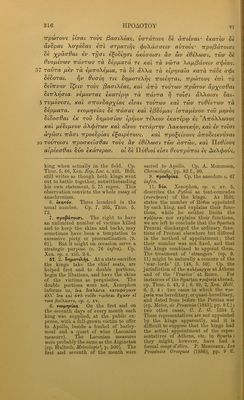
![op6(p Xo7p ‘^p€0}fiev(p P'^XP^' nepo-609 opOSi^ eLprjraL pou' airo 5e Aavdrj'i rt]<i 'AKpiaiov KaraXeyovTL roy? dvco alel 'irarkpa^ lo avTWV (paLvoiaro dv e6vre<i ol rcov Acopikcov '^yepov€<; Al- •yviTTLOL l0ay€V6€<;. ravra pcev vvv Kara ra ''EiXK7}ve<i XeyovcTL 54 yeyeverfKoyrjTaL' co? Be 6 'irapa Tlepaecov X0709 Xeyerat, avro<; 6 TLepcrev^ icov ’AacrvpLO<; iyevero EAXtjv, dW' ovk ol Tlepcreo^; TTpoyovoL' Toy? Be 'AKpLaiov ye irarepa^ 6po\oyeovTa<^ kut olKTiLOTTjra TLepaet ovBev, rovrov<; Be elvac, Kara irep ^Xk7]ve<; 5 XeyovaL, Alyvirriov^. Kat ravra fiev vvv Trepl rovrcov eiprjaOco. 6 ri Be eovre^ 55 merely of Perseid and Egyptian origin, but also through Argeia, mother of Eurysthenes and Prokles, have a further connexion with Thebes, and with the (Phoenician) Kadmeans. In fact, if it were not for the intervention of the (Hellenic) Zeus as father first of Perseus and then of Herakles, there would not be much to say for the Hellenic origin of the kings of the Dorians. 9. 6p0w Xciyo), A phrase which like many others is popular and historical before it becomes scientific. Cp. c. 68 infra. 64. 2. 6 Trapd Ilepcrewv Xdyos X^yerai. We cannot be sure that these words mean more than that the Persian account was reported to Hdt. or found by him in his authorities. Cp. Intro- duction, p. Ixxix. 3. Ilcptrevs e«v ’Ao-(rvpios. The ‘ Persian ’ view is that Perseus and his ancestors were ‘Assyrians,’ and that he was the first of the family to ‘ become a Hellene.’ According to the ‘Persian’ legend given in 7. 150, Perses, the e^onym of the Persians, was a son of Perseus, son of Danae, and Andro- meda, daughter of Kepheus. Kepheus is the son of Belos (7. 61). Accord- ing to the genealogy in 1. 7, Belos is father of Ninos, and son of Alkaios son of Herakles. This Herakles would be the Asiatic or Tyrian Herakles not the Greek, 2. 44. The Syrian and Assyrian connexion is through Andromeda not Perseus, and the argu- ment in 7. 150 implies the Argive origin of Perseus. That is also tlie implication of the passage 7. 61. Ac- cording to the story here Perseus has notliing to say to Danae or to Akrisios. That the kings or chieftains of the Dorians were really of ‘ Assyrian ’ or Egyptian descent is more improbable than that they were of non-Dorian origin. The ‘ Egyptian ’ hypothesis was the common Greek view; but the license of conjecture practised by the ‘ Persians ’ is an indication of the way in which these stories or genealogies originated or developed. The Egyptian origin of the Herakleids is, perhaps, largely a product of the attempt to connect the Greeks and their civilisation with the oldest and wisest folk of antiquity, of which we have other examples in the Dodona legend, and the Egyptian origin of the Hellenic nomenclatm-e of the Deities, 2. 50, 54 ft’. At the same time it should be re- cognised that not merely tradition but archaeology points to a real intercourse between Egypt and Greece, particularly Argos, long before the days of Psamatik I. (Cp. P. Gardner, New Chapters in Creek History, esp. cc. v., vii.) The Phoenicians may have been the carriers and go-betweens in a later ‘ middle age, ’ but the probabilities now point more and more to a belief in early movements and intercourse between Europe and Egypt (cp. F. Petrie, J. H. 8. xii. 199 ft. 1891), though it is not at present credible that any Egyptian dynasty was established in Greece. So freely, in fact, were these obscure but real connexions handled by the contemporaries of Herodotus that Argos itself was made the ancestral home of the Danaids, whose advent there is consequently a return to their native land (Aischylos, Supp. 15 ft.). Cp. Hdt. 1. 1, whore lo is at home in Argos. lo is the mother of Epaphos (cp. 3. 27) from whom Aigyptos and Danaos are descended.](https://iiif.wellcomecollection.org/image/b24872416_0001_0441.jp2/full/800%2C/0/default.jpg)