Volume 1
Herodotus : the fourth, fifth, and sixth books / With introduction, notes, appendices, indices, maps by Reginald Walter Macan.
- Herodotus
- Date:
- 1895
Licence: Public Domain Mark
Credit: Herodotus : the fourth, fifth, and sixth books / With introduction, notes, appendices, indices, maps by Reginald Walter Macan. Source: Wellcome Collection.
446/528 (page 318)
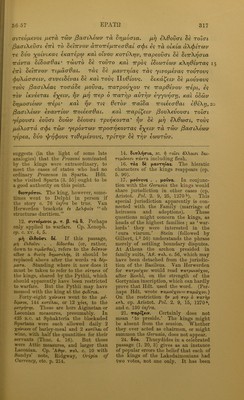
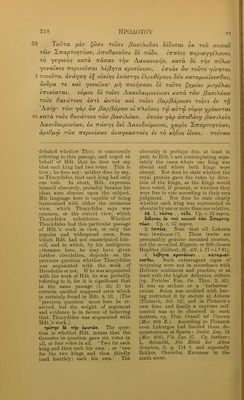
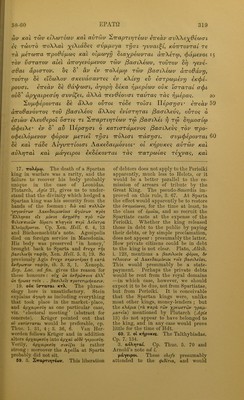
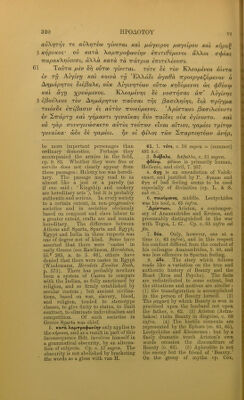
![VI 58 TaCro. fiev '<^o)cn rolcn ^aaiXevaL BeBorat e/c tov kolvov TMv ^7rapTL7]T€oyv, airodavovcTL Be rdBe. i7r7ree<^ TreptayyeXovcrL TO yeyovo<; Kara Trdaav t^v Kaicoiviicrjv, Kara Be r^v ttoXlv yvvaLKe<i 'irepaovcrai Xe/SrjTa KporeovcTL. eiredv S)v tovto ylvTjTaL 5 ToiovTO, avdyKT] e^ olKLr]<; eicdarr'q<; eXevOepov^ Bvo KarapbLaiveaOaL, avBpa re KaX yvvalica' pd) 'iroirjaaai Be tovto ^7}p,laL pLeydXat eTTLKeaTab. vopio^ Be tolctl AaKeBatpovloiaL kutu tmv ^aaCXecov TOv<i 6avdTov<i ecTTL d)VTo<i KaX tolctl (Sap^dpoLcrL tolctl ev Trj AcTLrj’ TO)v yap d)V jSap/Sdpcdv ol 7rXevve<i tw avTcp vopLcp '^pecovTaL lo KaTa Tov<; 9avdTov<; tcov ^acTLXecov. iTredv yap aTToOdvr] ^aaLXev<; AafceBaLpLovLcov, e/c irdcTrj^i Bel AaKeBaipLovo<;, ‘^copX<i ^TcapTLTjTecov, dpL$pL(p TOiV TrepLOLKcov dvayKacTTov'^ e<? to K7]Bo<i levaL. tovtcov debated wlietlier Thuc. is consciously- referring to this passage, and urged on behalf of Hdt. that he does not say that each king had two votes. This is true ; he does not: neither does he say, as Thucydides, that each king had only one vote. In short, Hdt. expresses himself obscurely, probably because his ideas were obscure upon the subject. His language here is capable of being harmonised with either the erroneous view, which Thucydides says was common, or the correct view, which Thucydides substitutes. Whether Thucydides had this particular passage of Hdt.’s work in view, or only the popular and widespread error, from which Hdt. had not emancipated him- self, and to which, by his ambiguous utterance here, he may have given further circulation, depends on the previous question whether Thucydides was acquainted with the work of Herodotus or not. If he was acquainted with the work of Hdt. he was probably referring to it, for it is significant that in the same passage (1. 20, 3) he corrects another supposed error which is certainly found in Hdt. 9. 53. (The ‘previous question’ must here be re- served, but the weight of argument and evidence is in favour of believing that Thucydides was acquainted with Hdt.’s work.) Tpfrqv Si T^|v ewvTMv. The ques- tion is whether Hdt. means that the Gerontes in question gave six votes in all, or four votes in all. ‘ Two for each king and then each his own ’ : or ‘ two for the two kings and then thirdly (and fourthly) each his own.’ The obscurity is perhaps due, at least in part, to Hdt. ’s not contemplating sepa- rately the cases where one king was absent and where both kings were absent. Nor does he state whether the royal proxies gave the votes by direc- tion of the kings, as the kings would have voted, if present, or whether they were free to vote according to their own judgment. Nor does he state clearly whether each king was represented in absentia by one or more than one relative. 68. 1. ravra . . rdSe. Cp. c. 53 swpra. SeSorai Ik toO koivov twv SirapriT]- tIwv. Cp. c. 57 supra. 2. tirTT-les. Note that all Lakonia was lTnrd<n/jLos (?). These Imr^es are presumably genuine mounted couriers, not the so-called, Hippeis, or 300 chosen Hoplites (Gilbert, St. Alt. i. 77 = i.* 81). 4. Xip-rjTa KpOT€ov(Ti . . KarapiaC- v€<r9ai. Such extravagant signs of mourning were not in accordance with Hellenic sentiment and practice, or at least with the higher Athenian culture (cp. Pericles’ Fun. Or. Thuc. 2. 45). It was an archaic or a ‘ barbarous ’ excess. Solon was credited with hav- ing restricted it by statute at Athens (Plutarch, Sol. 12), and in Plutarch’s own time and family a supreme self- control was to be observed in such matters, cp. Plut. Consol, ad Uxorem {Mor. 608 ff.). According to Plutarch even Lykurgos had limited these de- monstrations at Sparta : Instil. Lac. 18 {Mor. 238), Vit. Lyc. 27. Cp. further: L. Schmidt, Die Ethik der Alien Q-nechen, ii. p. 114 f. and especially Bekker, Charicles, Excursus to the ninth scene.](https://iiif.wellcomecollection.org/image/b24872416_0001_0446.jp2/full/800%2C/0/default.jpg)