Volume 1
Herodotus : the fourth, fifth, and sixth books / With introduction, notes, appendices, indices, maps by Reginald Walter Macan.
- Herodotus
- Date:
- 1895
Licence: Public Domain Mark
Credit: Herodotus : the fourth, fifth, and sixth books / With introduction, notes, appendices, indices, maps by Reginald Walter Macan. Source: Wellcome Collection.
451/528 (page 323)
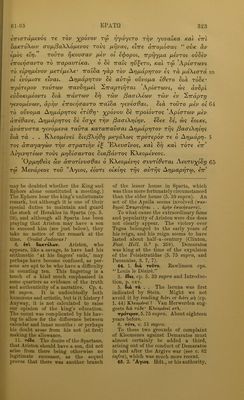
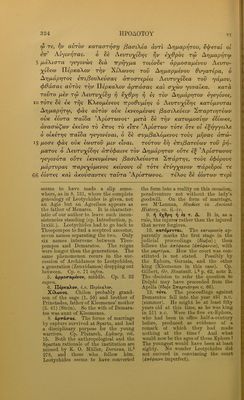
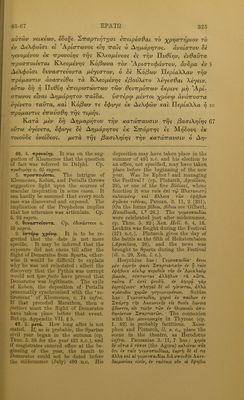
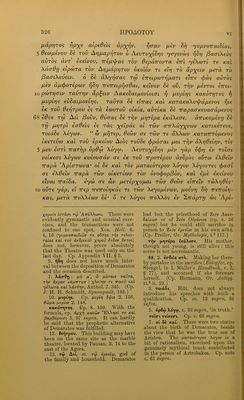
![e7riaTdfX€v6<; t€ tov '^povov rw '^’yd'yero ryv ywatKa Kal cttI BaKTv\o)v (TvpL/SaWofxevo'i tou9 pirjva^, elire aTro/xoca? “ ovk dv epo<i €L7]. rovTO ijKovcrav p,ev oi ecpopot, irprj<ypja puevTOL ovBev e'TTOi'qo'avTo to TrapavTLKa. 6 Be Trat? rjv^eTo, Kal tw ^KpiarcdVL TO elpr)pLevov /xereyu-eXe* iralBa yap tov /^r)pLapr]Tov e? to, pLoXiaTa lo 01 evopLLae elvai. Arjpidp7}Tov Be avTM ovvopua eOeTO Bid ToBe' TrpoTepov TovTcov TravBypLel ’ZTrapTLrjTai 'KpLaTcovt,, co? dvBpl evBoKipLeovTL Bid TrdvTcov B^ tmv /SaaiXecov tcov ev 'ZirdpTy yevop^evcdv, dp^v eiroi'^aavTO TralBa yeveaOai. Bid tovto piev oi 64 TO ovvopa Ar]p,dpT]TO<; eTeOrj' '^povov Be nrpolovTO’i ^ApicTTcov piev diredave, ArjpidprjTO^ Be eV^e t^v ^aaiXrjirjv. eBee Be, to? eoiKe, dvdirvaTa yevopieva TavTa KaTairavaai ArjpbdprjTov Trj<; /SacriXrjlTj^; Bid Ta . . KXeopieve'i Bie^X'ijOrj /xeyaXco? irpoTepov Te 6 Ar}p,dpr}- 5 TO? dirayaydiv t^v aTpaTi^v e^ ’EXeoo'ii'o?, Kal B^ Kal TOTe e7r’ AiyiV7}T€cov Tov<; pnjBiaavTa<; Bia^dvTO<i KXeo/xei^eo?. 'Oppir}6el<i o)v diroTivvadai 6 KXeo/xez/?;? crvvTiOeTai AeoTV^iBr) 65 T(p Mevapeo? tov Ayio^, eovTi oIkItj^; t^? avTrj^i Arjpiap'qTip, eir may be doubted whether the King and Ephors alone constituted a meeting.) The Ephors hear the king’s unfortunate remark, but although it is one of their special duties to maintain and guard the stock of Herakles in Sparta (cp. 5. 39), and although all Sparta has been praying that Ariston may have a son to succeed him (see just below), they take no notice of the remark at the time. Credat Judaeus ! 6. Iirl SaKTvXuv. Ariston, who appears, like a savage, to have had his arithmetic ‘ at his fingers’ ends,’ may perhaps have become confused, as per- sons are apt to be who have a difficulty in counting ten. This fingering is a touch of a kind much emphasised in some quarters as evidence of the truth and authenticity of a narrative, Cp. 4. 98 supra. It is undoubtedly both humorous and artistic, but is it history ? Anyway, it is not calculated to raise our opinion of the king’s education. The count was complicated by his hav- ing to allow for the difference between calendar and lunar months ; or perhaps his doubt arose from his not (at first) making the allowance. 11. t<58€. The desire of the Spartans, that Ariston should have a son, did not arise from there being otherwise no legitimate successor, as the sequel proves that there was another branch of the lesser house in Sparta, which was thus more fortunately circumstanced than the elder house (5. 39 supra). An act of the Apella seems involved {ira.v- drifiel STraprt^rat . . dpi]i> iiroLiiaavTo). To what cause the extraordinary fame and popularity of Ariston were due does not clearly appear. The victory over Tegea belonged to the early years of his reign, and his reign seems to have lasted about half - a - century (Clinton, Fast. Hell, ii.® p. 258). Demaratos was king at the time of the expulsion of the Peisistratidae (5. 75 supra, and Pausanias, 3. 7, 7). 64. 1. Bid TOVTO. Rawlinson cps. “ Louis le Desire.” 3. ^8«€, cp. 5. 33 supra and Introduc- tion, p. cxv. 5. 8id Ttt . . The lacuna was first indicated by Stein. Might we not avoid it by reading Si&ri or 5i6rt (cp. 1. 44) KAeo/i^vci’? Van Herwerden sug- gests 5id rdSe* KXeoya^vci kt\. irp^Ttpov, 5.75 supra. About eighteen years before. 6. t6t€, c. 51 supra. To these two grounds of complaint of Kleomenes against Demaratos must almost certainly be added a third, arising out of the conduct of Demaratos in and after the Argive war (see c. 82 infra), which was much more recent. 66. 2. Ayios. Hdt., or his authority,](https://iiif.wellcomecollection.org/image/b24872416_0001_0451.jp2/full/800%2C/0/default.jpg)