Volume 1
Herodotus : the fourth, fifth, and sixth books / With introduction, notes, appendices, indices, maps by Reginald Walter Macan.
- Herodotus
- Date:
- 1895
Licence: Public Domain Mark
Credit: Herodotus : the fourth, fifth, and sixth books / With introduction, notes, appendices, indices, maps by Reginald Walter Macan. Source: Wellcome Collection.
452/528 (page 324)
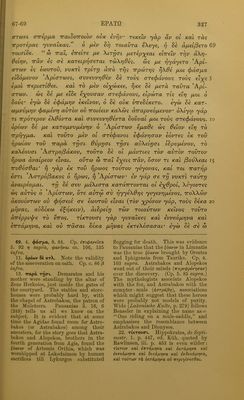
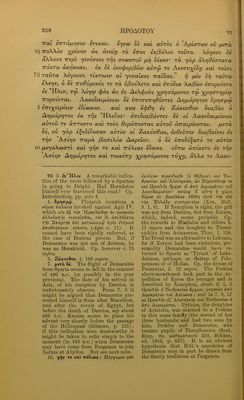
![vr w re, rjv avrov Karacrr'^arj jSacnXea uvrl ^rjfxaprjrov, e^lrerau ol eir Al<yLvr}ra^. 6 he AevTU'^iBrj^; rjv e')(6po<; tw ATjpLaprjTw 5 pLaXiara <yeyovoi)<i hia ’jrprjyp.a roLovhe’ appboaapbevov Aevrv- ‘^iSeco TlepKaXov r^v X/Xcoz/o? rov Ar]p,app,evov Ovyarepa, 6 Ar]p,dp7]T0<; im^ovXevcraf; d/rroarepeeL Aevrv^iBea rov ydpiov, (f)0d(7a'i avrb<; r^v TiepKaXov dpirdtja^ koX a'ydiv yvvaiica. Kara rovro piev tw Aevrv'^Lhy 97 e'^Oprj 97 e<? tov Ar)pLdp7}Tov iyeyovee, 10 Tore Be e/c T7j<; KXeopLeveo<f TrpoOvfiLrj^; 0 AevTV'^iBr)<; KaropLvvrai, At}pbapijrw, (f)d<; avrov ov/c lKveofM€vo)<i ^aaCkeveiv ’ZTraprtrjrewv ovK eovra TralBa ’Aptcrrfuvo? • pberd Be r^v Karwpboalnfjv eBiwKe, dvaad)^cov eKelvo to eVo? to elire 'ApLarwv rore ore ol e^TqyyeiXe 6 olKerrjf; iraoBa yeyovevai, 6 Be avpi^a\6pLevo<; too? pLrjva<; dird)- 15 pLocre (j)d<i ovk eoovrov puv elvau. rovrov B^ em^arevcov rov p'p- pLaro<i o Aevrv)^lBr}<^ d7re(f)aLve rov ArjpLdprjrov ovre 'ApLaT(ovo<; yeyovora ovre LKvevpLeva)<; ^aaiXevovra XTrdprr)^, tov? i<f)6pov<; pLdprvpa<; irape'^opLevo'i Keivov<; ot rore ervyyavov irdpeBpol re 66 iovre^ Kal aKovaavre^ ravra 'Apiarrcovo^;. TeXo? Be eovrcov Trepl seems to have made a slip some- where, as in 8. 131, where the complete genealogy of Leotychides is given, not an Agis but an Agesilaos appears as the father of Menares. It is character- istic of our author to leave such incon- sistencies standing (cp. Introduction, p. Ixxiii.). Leotychides had to go hack to Theopompos to find a sceptred ancestor, seven names separating the two. Only six names intervene between Theo- pompos and Demaratos. The reigns were longer than the generations. The same phenomenon recurs in the suc- cession of Archidamos to Leotychides, a generation (Zeuxidamos) dropping out between. Cp. c. 71 infra. 5. ap|io<ra|Ji^vov, middle. Cp. 5. 32 supra. 6. n^pKaXov, i.e. JlepiKa\ov. XCXcovos. Chilon probably grand- son of the sage (1. 59) and brother of Prinetades, father of Kleomenes’ mother (5. 41) (Stein). So the wife of Demara- tos was aunt of Kleomenes. 8. apirdo-as. The forms of marriage by capture survived at Sparta, and had a disciplinary purpose for the young warriors. Cp. Plutarch, Lykurg. vit. 15. Both the anthropological and the Spartan rationale of the institution are missed by K. O. Muller, Dorians, ii.^ 278, and those who follow him. Leotychides seems to have converted the form into a reality on this occasion, peradventure not without the lady’s goodwill. On the form of marriage, see M'Lennan, Studies in Ancient History, cc. ii.-iv. 9. T| A. It is, as a rule, the injurer rather than the injured that never forgives. 10. KaxdfjivvTai. The Karwuoaiy ap- parently marks the first stage in the judicial proceedings (dLw^is); then follows the dirdcpaais {dT6<f>avcni), with the fiayrdpia. How tbe court was con- stituted is not stated. Possibly by the Ephors, Gerusia, and the other king (Kleomenes in this case). Cp. Gilb^ert, Gr. Staatsalt. i.^ p. 62, note 2. The 'decision to refer the question to Delphi may have proceeded from the Apella (^5o|e hirapTiijTrjai c. 66). 13. TOT€. The proceedings against Demaratos fall into the year 491 B.c. (summer). He might be at least fifty years old at this time, as he was king in 511 B.c. Were the five ex-Ephors, who had been in office half-a-century before, produced as evidence of a remark of which they had made nothing at the time ? And what would now be the ages of these Ephors ? The youngest would have been at least eighty. No wonder Leotychides did not succeed in convincing the court {itfi(pa.Lve imperfect).](https://iiif.wellcomecollection.org/image/b24872416_0001_0452.jp2/full/800%2C/0/default.jpg)