Volume 1
The devils and evil spirits of Babylonia : being Babylonian and Assyrian incantations against the demons, ghouls, vampires, hobgoblins, ghosts, and kindred evil spirits, which attack mankind / Tr. from the original cuneiform texts, with transliterations, vocabulary, notes, etc. by R. Campbell Thompson.
- Reginald Campbell Thompson
- Date:
- 1903-1904
Licence: Attribution-NonCommercial 4.0 International (CC BY-NC 4.0)
Credit: The devils and evil spirits of Babylonia : being Babylonian and Assyrian incantations against the demons, ghouls, vampires, hobgoblins, ghosts, and kindred evil spirits, which attack mankind / Tr. from the original cuneiform texts, with transliterations, vocabulary, notes, etc. by R. Campbell Thompson. Source: Wellcome Collection.
33/290 page 27
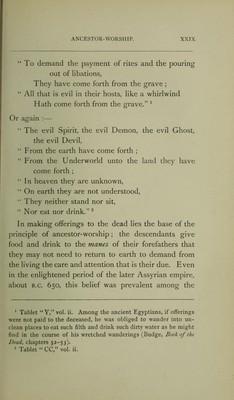
![was dying they would hover round his bed, and after his death would hail him as their father.1 There seems to be an allusion to this monstrous connection in the following extract from an Assyrian hymn to the Sun-god:—2 “ He on whom an evil Spirit hath rushed, “ He whom an evil Demon hath enveloped in his bed, “He whom an evil Ghost hath cast down in the night, “He whom a great Devil hath smitten, “ He whose limbs an evil God hath racked (?), “ He—the hair of whose body an evil Fiend hath set on end,3 “He whom ... [a Hag-demon] hath seized, “He whom [a Ghoul] hath cast down, “He whom a Robber-sprite hath afflicted, “ He whom the Handmaid4 of the Night-Phantom hath wedded, “ The man4 with whom the Handmaid of the Night-Phantom hath had union 5.” The third is the ekimmu or Departed Spirit, the soul of the dead person which for some reason 1 Ibid., p. 425. 2 W.A.I., V, 50, i, 41. 3 Cf. Job, iv, 15, “Then a spirit passed before my face; the hair of my flesh stood up.” 4 “Handmaid” and “man” are translations of the Assyrian words which have special reference to persons of marriageable age. 5 ikrimu, Syriac ^O'pO.](https://iiif.wellcomecollection.org/image/b24876069_0001_0035.jp2/full/800%2C/0/default.jpg)