Indoor pollution : status of federal research activities : report to the Ranking Minority Member, Committee on Government Reform, House of Representatives / United States General Accounting Office.
- United States. General Accounting Office
- Date:
- [1999]
Licence: Public Domain Mark
Credit: Indoor pollution : status of federal research activities : report to the Ranking Minority Member, Committee on Government Reform, House of Representatives / United States General Accounting Office. Source: Wellcome Collection.
22/88 page 20
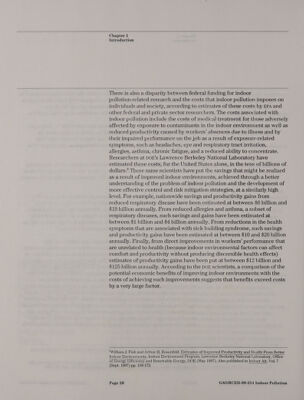
![Chapter 1 Introduction There is also a disparity between federal funding for indoor pollution-related research and the costs that indoor pollution imposes on individuals and society, according to estimates of these costs by EPA and other federal] and private sector researchers. The costs associated with indoor pollution include the costs of medical treatment for those adversely affected by exposure to contaminants in the indoor environment as well as reduced productivity caused by workers’ absences due to illness and by their impaired performance on the job as a result of exposure-related symptoms, such as headaches, eye and respiratory tract irritation, allergies, asthma, chronic fatigue, and a reduced ability to concentrate. Researchers at DOE’s Lawrence Berkeley National Laboratory have estimated these costs, for the United States alone, in the tens of billions of dollars.’ These same scientists have put the savings that might be realized as a result of improved indoor environments, achieved through a better understanding of the problem of indoor pollution and the development of more effective control and risk mitigation strategies, at a similarly high level. For example, nationwide savings and productivity gains from reduced respiratory disease have been estimated at between $6 billion and $19 billion annually. From reduced allergies and asthma, a subset of respiratory diseases, such savings and gains have been estimated at between $1 billion and $4 billion annually. From reductions in the health symptoms that are associated with sick building syndrome, such savings and productivity gains have been estimated at between $10 and $20 billion annually. Finally, from direct improvements in workers’ performance that are unrelated to health (because indoor environmental factors can affect comfort and productivity without producing discernible health effects) estimates of productivity gains have been put at between $12 billion and $125 billion annually. According to the DOE scientists, a comparison of the potential economic benefits of improving indoor environments with the costs of achieving such improvements suggests that benefits exceed costs by avery large factor. SWilliam J. Fisk and Arthur H. Rosenfeld, Estimates of Improved Productivity and Health From Better Indoor Environments, Indoor Environment Program, Lawrence Berkeley National Laboratory, Office of Energy Efficiency and Renewable Energy, DOE (May 1997). Also published in Indoor Air, Vol. 7 (Sept. 1997) pp. 158-172.](https://iiif.wellcomecollection.org/image/b3223059x_0022.jp2/full/800%2C/0/default.jpg)