Indoor pollution : status of federal research activities : report to the Ranking Minority Member, Committee on Government Reform, House of Representatives / United States General Accounting Office.
- United States. General Accounting Office
- Date:
- [1999]
Licence: Public Domain Mark
Credit: Indoor pollution : status of federal research activities : report to the Ranking Minority Member, Committee on Government Reform, House of Representatives / United States General Accounting Office. Source: Wellcome Collection.
24/88 page 22
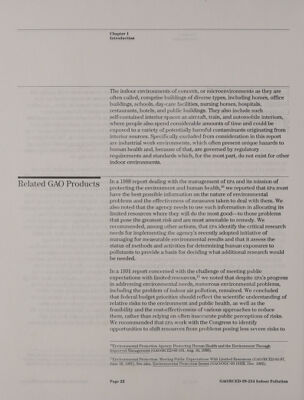
![Chapter 1 Introduction Related GAO Products The indoor environments of concern, or microenvironments as they are often called, comprise buildings of diverse types, including homes, office buildings, schools, day-care facilities, nursing homes, hospitals, restaurants, hotels, and public buildings. They also include such self-contained interior spaces as aircraft, train, and automobile interiors, where people also spend considerable amounts of time and could be exposed to a variety of potentially harmful contaminants originating from interior sources. Specifically excluded from consideration in this report are industrial work environments, which often present unique hazards to human health and, because of that, are governed by regulatory requirements and standards which, for the most part, do not exist for other indoor environments. In a 1988 report dealing with the management of EPA and its mission of protecting the environment and human health,!° we reported that EPA must have the best possible information on the nature of environmental problems and the effectiveness of measures taken to deal with them. We also noted that the agency needs to use such information in allocating its limited resources where they will do the most good—to those problems that pose the greatest risk and are most amenable to remedy. We recommended, among other actions, that EPA identify the critical research needs for implementing the agency’s recently adopted initiative of managing for measurable environmental results and that it assess the status of methods and activities for determining human exposures to pollutants to provide a basis for deciding what additional research would be needed. In a 1991 report concerned with the challenge of meeting public expectations with limited resources,!! we noted that despite EPA’s progress in addressing environmental needs, numerous environmental problems, including the problem of indoor air pollution, remained. We concluded that federal budget priorities should reflect the scientific understanding of relative risks to the environment and public health, as well as the feasibility and the cost-effectiveness of various approaches to reduce them, rather than relying on often inaccurate public perceptions of risks. We recommended that EPA work with the Congress to identify opportunities to shift resources from problems posing less severe risks to “Environmental Protection Agency: Protecting Human Health and the Environment Through Improved Management (GAO/RCED-88-101, Aug. 16, 1988). Environmental Protection: Meeting Public Expectations With Limited Resources (GAO/RCED-91-97, June 18, 1991). See also, Environmental] Protection Issues (GAO/OGC-93-16HR, Dec. 1992).](https://iiif.wellcomecollection.org/image/b3223059x_0024.jp2/full/800%2C/0/default.jpg)