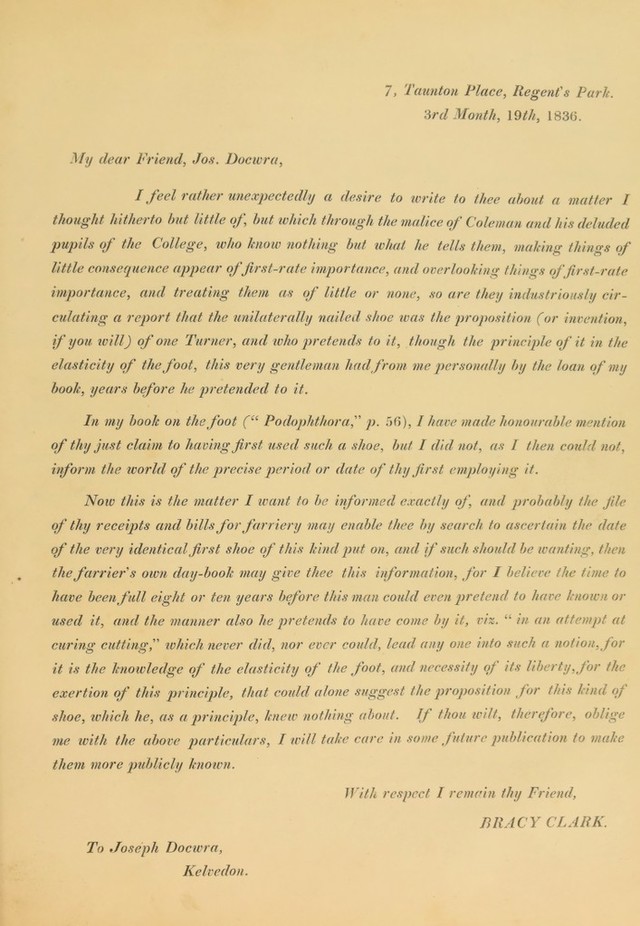
[Letter to Joseph Docwra, and his reply, on the date of the first use of the unilaterally nailed horse shoe] / [Bracy Clark].
- Bracy Clark
- Date:
- [1836]
Licence: Public Domain Mark
Credit: [Letter to Joseph Docwra, and his reply, on the date of the first use of the unilaterally nailed horse shoe] / [Bracy Clark]. Source: Wellcome Collection.
10/18 page 2
![Iii the present day, whilst such baneful practices are seen in almost every Forge, it becomes an imperative duty for the master to see after these matters himself, and give a personal attendance on these occasions, which may he done by setting aside about one hour in every month for this purpose, which is surely no very great difficulty or sacrifice of time; by which he might save many a valuable Horse, many an accident, and probably render many a journey pleasant, that might otherwise he both painful and dangerous, which would amply requite his labour and attention. In entering upon this requisite duty, he would do well to chose an hour of the day when the shop is least likely to be thronged with horses, and whilst the light is yet good. The Shoeing-forge, to he a good one, should have plenty of light, not from sky-lights only over the Horses’ hacks, but side lights also, that a good view may he obtained of what is ])assing. If much drink is going about the Forge, or there is much noisy talking or bawling to the Horses, or cant among the men, and a self-sufficiency and saucy indifference, such a shop at once shun, and if there he no better, endeavour to get others established, by due encouragement held out to more reasonable individuals; for there is no want of hands in this very necessary department of human labor at this time, nor is ever likely to be; or if they are observed to treat the Horses roughly with their hammers, or terrify them unnecessarily, take them elsewhere; since gentle measures will nearly always succeed best with these animals, as the truly experienced in Horses can well testify. In tying the Horse up, see that the halter or rope does not offend his ears or his fore-top, or rub his eye, or damage his throat, for they are often rudely treated in this respect, and vice generated by it, which w ill not afterwards perhaps be very easily subdued. In proceeding to take the shoes off', observe that he unclenches every nail, and does not cut pieces out of the hoof with his buffer* in doing it; after the nails are unclenched, let him pull off the shoe with his pincers, for some lazily rip it off without doing this, or but very imperfectly, and so tear away whole pieces of the horn, by which future shoeings are rendered difficult, the want of horn making it necessary to go too near the quick; and this evil may so increase at every shoeing, that it shall become highly dangerous or absolutely impossible to drive the nails without compressing the quick, and occasioning lameness or accidents, or finally perhaps the loss of the Horse. Also, if the nails are not duly unclenched, the force with which the pincers meet the sole to wrench it off, shall bruise this part, and give unnecessary pain, especially if it he thin and tender, it is therefore well, in such feet, to see that as many of the nails as may be are not only unclenched, but individually drawn out by the pincers : for a broken hoof, getting often from bad to worse, is a long time in being brought about again, and sometimes the horse is ruined before it is accomplished by untoward accidents: for the hoof grows but slowly, and fresh breakages easily follow the first. Many persons have been led into frightful notions about the burning of horses’ feet with red hot shoes; but here the alarm has been greater than the need; a man cannot put on a red hot shoe, as it is necessary he should first take it into his hands; he may however in fitting the shoe burn the sole, and the heat passing through scorch the quick, and therefore, in nag horses at any rate, if more than the slightest touch is used with the red hot shoe, just sufficient to mark the bearings, you should make him desist, and the heat of the shoe need not be more considerable, than is just sufficient to blacken the points of contact, as it shows them the bearings better than by any other way: it is not however often that mischief arises from this source. * A square, short, iron knife, to cut off the clenches with.](https://iiif.wellcomecollection.org/image/b22005730_0010.jp2/full/800%2C/0/default.jpg)