Teenage pregnancy / report by the Social Exclusion Unit ; presented to Parliament by the Prime Minister by command of Her Majesty, June 1999.
- Great Britain. Social Exclusion Unit
- Date:
- 1999
Licence: Open Government Licence
Credit: Teenage pregnancy / report by the Social Exclusion Unit ; presented to Parliament by the Prime Minister by command of Her Majesty, June 1999. Source: Wellcome Collection.
122/144 (page 120)
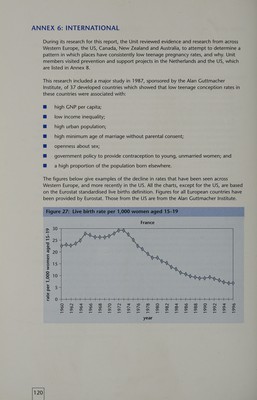
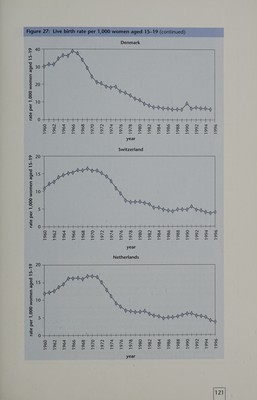
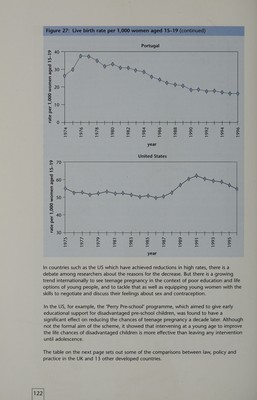
![ANNEX 6: INTERNATIONAL During its research for this report, the Unit reviewed evidence and research from across Western Europe, the US, Canada, New Zealand and Australia, to attempt to determine a pattern in which places have consistently low teenage pregnancy rates, and why. Unit members visited prevention and support projects in the Netherlands and the US, which are listed in Annex 8. This research included a major study in 1987, sponsored by the Alan Guttmacher Institute, of 37 developed countries which showed that low teenage conception rates in these countries were associated with: high GNP per capita; low income inequality; high urban population; high minimum age of marriage without parental consent; openness about sex; government policy to provide contraception to young, unmarried women; and a high proportion of the population born elsewhere. The figures below give examples of the decline in rates that have been seen across Western Europe, and more recently in the US. All the charts, except for the US, are based on the Eurostat standardised live births definition. Figures for all European countries have been provided by Eurostat. Those from the US are from the Alan Guttmacher Institute. N oO rate per 1,000 women aged 15-19 cr 10 5 0 oO N Si: ‘Oo ioe) oO N t+ \o ioe] So N vt \o co io) N Nt \o \o \o \o \o \o nN N ~N ~ ~ foe) 0 co 0 co OV’ ON oO’ fons ON OV ON ON ions ON ON ON ON ON ON ON ON ON ON ON ON ON Ov — = —_ — es = = = = = = a! = = — = Les L neers _](https://iiif.wellcomecollection.org/image/b32222683_0122.jp2/full/800%2C/0/default.jpg)