Hallucinations and illusions : a study of the fallacies of perception / by Edmund Parish.
- Edmund Parish
- Date:
- 1897
Licence: Public Domain Mark
Credit: Hallucinations and illusions : a study of the fallacies of perception / by Edmund Parish. Source: Wellcome Collection.
Provider: This material has been provided by the Francis A. Countway Library of Medicine, through the Medical Heritage Library. The original may be consulted at the Francis A. Countway Library of Medicine, Harvard Medical School.
40/426 page 20
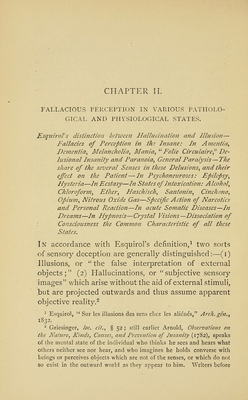
![the meaning of the two words, we shall adopt, at least for the present, the usual distinction, employing illusion to denote a sensory deception which may be referred to some external nerve stimulus, and hallucination to denote one which cannot so be referred. One other distinction must be briefly considered, the division, namely, of hallucinations into positive and negative. While by the former is meant the subjective perception of an object where there is none, by the latter is understood the hallucinatory non- perception of an object which is present. As there is considerable confusion about the exact nature of negative hallucinations, 1 shall refer to the question in more detail later, and content myself here with this brief reference. Fallacious Perception in Insanity.—The most fre- quently quoted of all sense-deceptions are those of insanity. Some authors have sought to divide them according to their origin into idiopathic, those which are primary but which may also occur in secondary consensual morbid states, and sympto- matic, those which occur only as a secondary symptom of insanity.^ In any case a distinction ought to be drawn between sporadic hallucinations not associated with particular emotional states and hallucinations which reflect the ruling mental tone. This distinction has prognostic importance, since •^ Kieser, Elemente der PsycJiiatrie, p. 298; Michea, op. cii. Moreau, Alemoire stir le iraitement des ]ialhicinations par le datura stravioniiitn^ divides hallucinations as follows:—I, those which are isolated and occur without any widespread mental disturbance, and of the subjective origin of which the patient is aware ; 2, those which, though indeed primary phenomena, are associated with more or less profound psychical disturbance; 3, those which are not the causes but the results of mental alienation.](https://iiif.wellcomecollection.org/image/b2107141x_0040.jp2/full/800%2C/0/default.jpg)



 No text description is available for this image
 No text description is available for this image
 No text description is available for this image