Volume 1
On vaccine therapy and immunisation in vitro : based on an address to the Medical Society of London on October 27th, 1930 / by Sir Almroth Wright.
- Almroth Wright
- Date:
- [1931?]
Licence: Public Domain Mark
Credit: On vaccine therapy and immunisation in vitro : based on an address to the Medical Society of London on October 27th, 1930 / by Sir Almroth Wright. Source: Wellcome Collection.
5/56
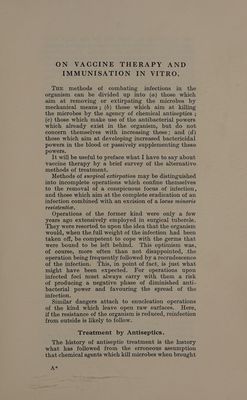
![IMMUNISATION IN VITRO. THE methods of combating infections in the organism can be divided up into (a) those which aim at removing or extirpating the microbes by mechanical means; (b) those which aim at killing the microbes by the agency of chemical antiseptics ; (c) those which make use of the antibacterial powers which already exist in the organism, but do not concern themselves with increasing these; and (d) those which aim at developing increased bactericidal powers in the blood or passively supplementing these powers. It will be useful to preface what I have to say about. vaccine therapy by a brief survey of the alternative methods of treatment. Methods of surgical extirpation may be distinguished into incomplete operations which confine themselves to the removal of a conspicuous focus of infection, and those which aim at the complete eradication of an infection combined with an excision of a locus minoris resistenti@. Operations of the former kind were only a few years ago extensively employed in surgical tubercle. They were resorted to upon the idea that the organism would, when the.full weight of the infection had been taken off, be competent to cope with the germs that were bound to be left behind. This optimism was, of course, more often than not disappointed, the operation being frequently followed by a recrudescence of the infection. This, in point of fact, is just what might have been expected. For operations upon infected foci must always carry with them a risk of producing a negative phase of diminished anti- bacterial power and favouring the spread of the infection. Similar dangers attach to enucleation operations of the kind which leave open raw surfaces. Here, if the resistance of the organism is reduced, reinfection from outside is likely to follow. Treatment by Antiseptics. The history of antiseptic treatment is the history what has followed from the erroneous assumption that chemical] agents which kill microbes when brought A*](https://iiif.wellcomecollection.org/image/b33442770_0001_0005.jp2/full/800%2C/0/default.jpg)