The Barber-Surgeons' Company : an address delivered to the Hunterian Society of London / by Thomas Glover Lyon.
- Lyon, Thomas Glover.
- Date:
- 1914
Licence: In copyright
Credit: The Barber-Surgeons' Company : an address delivered to the Hunterian Society of London / by Thomas Glover Lyon. Source: Wellcome Collection.
Provider: This material has been provided by The Royal College of Surgeons of England. The original may be consulted at The Royal College of Surgeons of England.
3/10
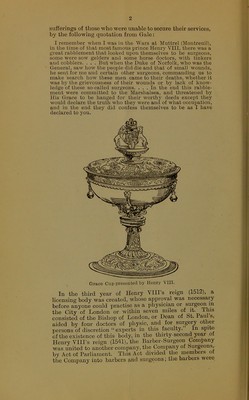
![COMPANY. the kind hospitality of the Worshipful Company of Barbers, the Hunterian Society is now privileged to hold its meetings in a place associated for centuries with the medical profession. In the year 1461 a cor- poration which had been solicited by Thomas Morsted, arms of the company. Chirurgien to Henry IV, was granted to Jacques de Fries, his physician, and John Hobbes, his surgeon, by Edward IV, in the names of St Cosmo and St. Damianus, brothers, physicians and martyrs. This corporation was called the Company of Barber-Surgeons of London, and received authority over all practising the same arts in and about the metropolis. In spite of this charter, however, many unqualified persons continued to practise. There is an interesting account of how quacks were punished in the minutes of the Company. In tifi.i, yna,- rJ the reign of Richard III one Roger Clark was prosecuted for quackery, having given a piece of parchment rolled up and said to be inscribed with the words of a charm, to be used round the neck against fever. The culprit was convicted and sentenced to the following peculiar punishment: He was “led through the middle of the city with trumpet and pipe, he riding on a horse without a saddle, the said parchment and a whetstone for his lies being hung about the neck, and an urinal being hung before him and another behind.” Up to the reign of Henry VIII barbery and surgery were practised by the same individual, but even during this period members of the Company specialized in one branch or the other. Many of those favouring surgery went to the wars cither in England or on the Continent. These were often financed by the barbers, who received a share of the large fees paid by the nobles and other wealthy men for surgical attendance. One can imagine how com- petent men were sought after, and how great were the [446/14] THE BA](https://iiif.wellcomecollection.org/image/b22448044_0005.jp2/full/800%2C/0/default.jpg)