Historia numorum : a manual of Greek numismatics / by Barclay V. Head.
- Barclay Vincent Head
- Date:
- 1887
Licence: Public Domain Mark
Credit: Historia numorum : a manual of Greek numismatics / by Barclay V. Head. Source: Wellcome Collection.
111/908 page 27
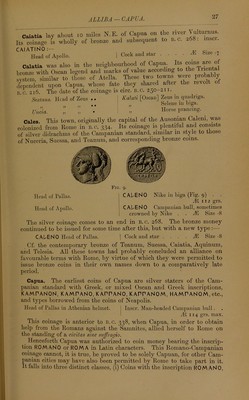
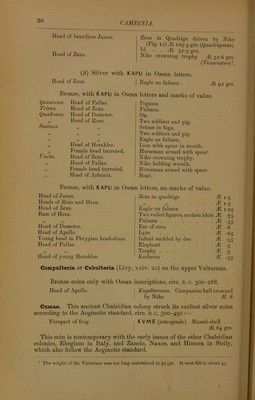
![ALLTBA — CAPUA. Caiatia lay about .0 miles N.E. of Capua on the river Vultumus. Its coinage is wholly of bronze and subsequent to B. c. 268: mscr. Head of Apollo. | Cock and star . ... JR Size .7 Caiatia was also in the neighbourhood of Capua. Its corns are of bronze with Oscan legend and marks of value according to the liiental system similar to those of Atella. These two towns were probably dependent upon Capua, whose fate they shared after the revolt of b.c. 216. The date of the coinage is circ. b.c. 250-21 i. Sextans. Head of Zeus >1 Uncia. Kalati [Oscan] Zeus in quadriga. Selene in biga. Horse prancing. Cales. This town, originally the capital of the Ausonian Caleni, was colonized from Home in b.c. 334. Its coinage is plentiful and consists of silver didrachms of the Campanian standard, similar m style to those of Nuceria, Suessa, and Teanum, and corresponding bronze coins. Fig. 9. Head of Pallas. CAUENO Nike in biga (Fig. 9) . . At 112 grs. Head of Apollo. CAUENO Campanian bull, sometimes crowned by Nike . . JR Size -8 The silver coinage comes to an end in B.c. 268. The bronze money continued to be issued for some time after this, but with a new type:— C AUENO Head of Pallas. | Cock and star . ... JR Size-8 Cf. the contemporary bronze of Teanum, Suessa, Caiatia, Aquinum, and Telesia. All these towns had probably concluded an alliance on favourable terms with Rome, by virtue of which they were permitted to issue bronze coins in their own names down to a comparatively late period. Capua. The earliest coins of Capua are silver staters of the Cam- panian standard with Greek, or mixed Oscan and Greek inscriptions, KAMPANON, KAMPANO, KAPPANO, KAPPANOM, HAMPANOM, etc., and types borrowed from the coins of Neapolis. Head of Pallas in Athenian helmet. Inscr. Man-beaded Campanian bull. At 114 grs. max. This coinage is anterior to B.c. 338, when Capua, in order to obtain help from the Romans against the Samnites, allied herself to Rome on the standing of a civitas sine suffrarjio. Henceforth Capua was authorized to coin money bearing the inscrip- tion ROMANO or ROMA in Latin characters. This Romano-Campanian coinage cannot, it is true, be proved to be solely Capuan, for other Cam- panian cities may have also been permitted by Rome to take part in it. It falls into three distinct classes, (i) Coins with the inscription ROMANO,](https://iiif.wellcomecollection.org/image/b24858572_0111.jp2/full/800%2C/0/default.jpg)




 No text description is available for this image
 No text description is available for this image
 No text description is available for this image