Historia numorum : a manual of Greek numismatics / by Barclay V. Head.
- Barclay Vincent Head
- Date:
- 1887
Licence: Public Domain Mark
Credit: Historia numorum : a manual of Greek numismatics / by Barclay V. Head. Source: Wellcome Collection.
35/908 page 31
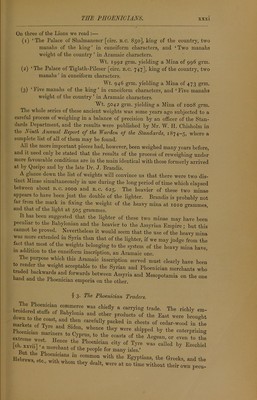
![THE PHOENICIANS. On three of the Lions we read :— (1) ‘The Palace of Shalmaneser [circ. B.c. 850], king of the country, two manahs of the king ’ in cuneiform characters, and ‘ Two manahs weight of the country ’ in Aramaic characters. Wt. 1992 grin, yielding a Mina of 996 grm. (2) ‘The Palace of Tiglath-Pileser [circ. B.c. 747], king of the country, two manahs ' in cuneiform characters. Wt. 946 grm. yielding a Mina of 473 grm. (3) ‘ Five manahs of the king’ in cuneiform characters, and ‘Five manahs weight of the country ’ in Aramaic characters. Wt. 5042 grm. yielding a Mina of 1008 grm. The whole series of these ancient weights was some years ago subjected to a careful process of weighing in a balance of precision by an officer of the Stan- dards Department, and the results were published by Mr. W. H. Chisholm in the Ainth Annual Report of the Warden of the Standards, 1874—5, where a complete list of all of them may be found. All the more important pieces had, however, been weighed many years before, and it need only be stated that the results of the process of reweighing under more favourable conditions are in the main identical with those formerly arrived af by Queipo and by the late Dr. J. Brandis. A glance down the list of weights will convince us that there were two dis- tinct Minae simultaneously in use during the long period of time which elapsed between about B.c. 2000 and B.c. 625. The heavier of these two minae appears to have been just the double of the lighter. Brandis is probably not far from the mark in fixing the weight of the heavy mina at 1010 grammes, and that of the light at 505 grammes. It has been suggested that the lighter of these two minae may have been peculiar to the Babylonian and the heavier to the Assyrian Empire; but this cannot be proved. Nevertheless it would seem that the use of the heavy mina was more extended in Syria than that of the lighter, if we may judge from the fact that most of the weights belonging to the system of the heavy mina have m addition to the cuneiform inscription, an Aramaic one. The purpose which this Aramaic inscription served must clearly have been to render the weight acceptable to the Syrian and Phoenician merchants who traded backwards and forwards between Assyria and Mesopotamia on the hand and the Phoenician emporia on the other. one § 3. The Phoenician Traders. n?r-e CUe% Can7in« trad<!- Tl* richly em- oidered stuffs of Babylonia and other products of the East were brought “ ’heats of cedar Zdt fL Phoem- • y • arid feldon’ wllence they were shipped by the enterprising extre™ lTnZc‘\l JPpT' ^ -he ^ °f AegCarl- “> [ch xxviil . ' ' Phoenician city of Tyre was called by Ezechiel L V“ merchant of the people for many isles/ Hehltetf Z WHh th6 EOTtia“S- the »d the ' e‘C Wlth whom ‘hey dealt, were at no time without their own pecu-](https://iiif.wellcomecollection.org/image/b24858572_0035.jp2/full/800%2C/0/default.jpg)



 No text description is available for this image
 No text description is available for this image
 No text description is available for this image