Historia numorum : a manual of Greek numismatics / by Barclay V. Head.
- Barclay Vincent Head
- Date:
- 1887
Licence: Public Domain Mark
Credit: Historia numorum : a manual of Greek numismatics / by Barclay V. Head. Source: Wellcome Collection.
68/908 page 64
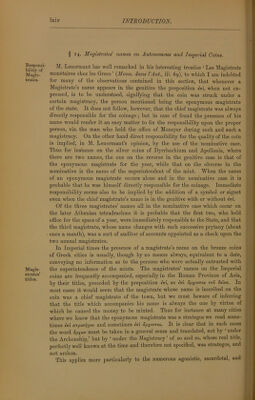
![Responsi- bility of Magis- trates. Magi- strates’ titles. § 14. Magistrates names on Autonomous and Imperial Coim. M. Lenormant has well remarked in his interesting treatise ‘ Les Magistrats monetaires chez les Grecs ’ (Monn. dans VAnt., iii. 69), to which I am indebted for many of the observations contained in this section, that whenever a Magistrate’s name appears in the genitive the preposition ini, when not ex- pressed, is to he understood, signifying that the coin was struck under a certain magistracy, the person mentioned being the eponymous magistrate of the state. It does not follow, however, that the chief magistrate was always directly responsible for the coinage ; but in case of fraud the presence of his name would render it an easy matter to fix the responsibility upon the proper person, viz. the man who held the office of Moneyer during such and such a magistracy. On the other hand direct responsibility for the quality of the coin is implied, in M. Lenormant’s opinion, by the use of the nomiuative case. Thus for instance on the silver coins of Dyrrhachium and Apollonia, where there are two names, the one on the reverse in the genitive case is that of the eponymous magistrate for the year, while that on the obverse in the nominative is the name of the superintendent of the mint. When the name of an eponymous magistrate occurs alone and in the nominative case it is probable that he was himself directly responsible for the coinage. Immediate responsibility seems also to be implied by the addition of a symbol or signet even when the chief magistrate’s name is in the genitive with or without ini. Of the three magistrates’ names all in the nominative case which occur on the later Athenian tetradrachms it is probable that the first two, who held office for the space of a year, were immediately responsible to the State, and that the third magistrate, whose name changes with each successive prytany (about • once a month), was a sort of auditor of accounts appointed as a check upon the two annual magistrates. In Imperial times the presence of a magistrate’s name on the bronze coins of Greek cities is usually, though by no means always, equivalent to a date, conveying no information as to the persons who were actually entrusted with the superintendence of the mints. The magistrates’ names on the Imperial coins are frequently accompanied, especially in the Roman Province of Asia, by their titles, preceded by the preposition ini, as ini dpxnvros toC 8eu>a. In most cases it would seem that the magistrate whose name is inscribed on the coin was a chief magistrate of the town, but we must beware of inferring that the title which accompanies his name is always the one by virtue of which he caused the money to be minted. Thus for instance at many cities where we know that the eponymous magistrate was a strategos we read some- times ini arparr]yov and sometimes inl apxovros. It is clear that in such cases the word dpx^v must be taken in a general sense and translated, not by ‘ under the Archonship,' but by ‘ under the Magistracy ’ of so and so, whose real title, perfectly well known at the time and therefore not specified, was strategos, and not archon. This applies more particularly to the numerous agonistic, sacerdotal, and](https://iiif.wellcomecollection.org/image/b24858572_0068.jp2/full/800%2C/0/default.jpg)



 No text description is available for this image
 No text description is available for this image
 No text description is available for this image