Historia numorum : a manual of Greek numismatics / by Barclay V. Head.
- Barclay Vincent Head
- Date:
- 1887
Licence: Public Domain Mark
Credit: Historia numorum : a manual of Greek numismatics / by Barclay V. Head. Source: Wellcome Collection.
72/908 page 68
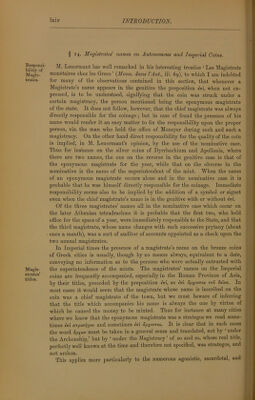
![nat'Tjyuptapxifjs, nanfjyupicmjs — Director of Public Festivals. Apameia (p- 558). Cadi (p. 560). NewKopos—A Magistrate entrusted with the care of a temple, probably that of the Augustan worship in the Province of Asia. (Coins of Lydia and Phrygia.) See also this title applied to cities. ©eoXoyos—Interpreter of Oracles. Pergamum (p. 464). ‘lepoprrjpwr—A Sacerdotal Officer, Sacred Recorder. Byzantium (p. 232). ’ApXiarpQs—Chief Physician. Heracleia Ioniae and Heracleia Salbace. Y'i6s Tm\ea)9—Son of the City. Attuda (p. 559), Cotiaeum (p. 561). 2o4>i<ttt]s Sophist. Smyrna (p. 5IO)> Laodiceia (p. 566), probably used as an honorary distinction by certain magistrates who happened also to be Sophists. ’Ap4>iKTuWs—The Amphictyons, Presidents of the Pythian games. Delphi (p. 289 sq.). ripoTroXoi—Ministers of the Temple. Delphi (p. 290). Among other titles, which are dynastic rather than magisterial, are 'Apxieptvs, AwdcTTrjs, and Touapxos, employed by the priestly family which ruled over Olba in Cilicia ; “Apx^v, used by Asander and Hygiaenon of Bosporus; 'Edvdpxrjs, the title of Herod Archelaus, and Terpapxrjs that of Ptolemy the son of Men- naeus, Lysanias I (p. 655), Herod Antipas, and Herod Philip II (p. 683). §15. Public Games and Sacred Festivals. Local Amphic- tyonies and itoiva. In all Greek lands there existed, from the earliest times down to the latest, certain uniform customs and common ties which served to bind together the divergent branches of the Hellenic race into one comparatively homogeneous family. ... TO ’EWtjvlkov iov op.aLp.6v re /cat opoyXaxrcrov, /cat de&v iSpvpara re KOiva /cat 6va[ai, rjBea re oporpona (Herod, viii. 144). Among these the Olympian, Pythian, Nemean, and Isthmian games were undoubtedly the most influential bonds of union. These great festivals may be regarded as types of many smaller associations of a similar character, local amphictyonies and Koiva of various districts, partly political and partly religious, common to the inhab- itants of one and the same district or to people of homogeneous race. So long as Greece remained free these common councils and periodical con- ventions exercised a well marked political influence and watched over the in- terests of the various cities which were enrolled as members of the Union, but under the rule of the Romans the political functions of the Koiva ceased to exist, although for purposes of common worship, and as a most valuable means of keeping the subject populations contented in the apparent exercise of their ancient privileges, and happy in the real performance of their time- honoured rites and sacrifices and in the enjoyment of frequently recurring splendid festivals, these gatherings were not only permitted, but were looked upon with an approving eye by the Emperor himself. As a stimulus to trade and as a convenient means of inculcating the Augustan worship the Common Games and Festivals of the Greeks were not only main- tained in many places where they already existed, but received still further extension at the hands of the Roman governors and of successive Emperors, under whose direct auspices many new festivals were founded, of which the](https://iiif.wellcomecollection.org/image/b24858572_0072.jp2/full/800%2C/0/default.jpg)



 No text description is available for this image
 No text description is available for this image
 No text description is available for this image