Historia numorum : a manual of Greek numismatics / by Barclay V. Head.
- Barclay Vincent Head
- Date:
- 1887
Licence: Public Domain Mark
Credit: Historia numorum : a manual of Greek numismatics / by Barclay V. Head. Source: Wellcome Collection.
73/908 page 69
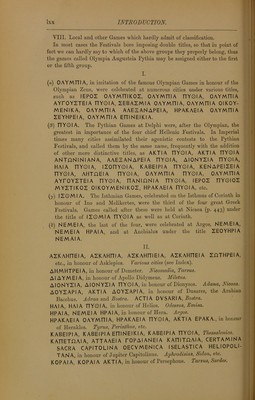
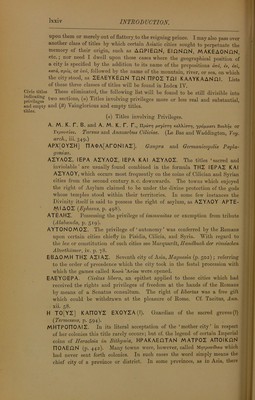
![tem})les of Rome and Augustus in the numerous metropolitan centres of the various provinces (more especially in Asia Minor) were the chief points of union. From the frequent mention of the Public Games on the coins of the Impe- Festival rial age struck in Greek cities, it is evident that these periodical festivals comaSe- everywhere created a demand for current coin in larger quantities than was sufficient for the ordinary requirements of the citizens. It is even probable that many of the less important towns only coined money at such times. On these occasions, when a great concourse of people poured into the city from the surrounding districts and from neighbouring towns, the magistrate whose function it was to arrange the details of the festival (’Ao-tap^f/?, dpytepeus, navr]- yvfnapxTis, dywoOerrjr, etc., by whatever title he may have been called), would, either at his own expense or on behalf of the ordinary municipal magistrates, cause an extra quantity of bronze money to be minted and put into circulation, and the name of the Festival for which the coin was struck would be inscribed in conspicuous characters usually across the field of the reverse. Most valuable is the information which may be gathered from these out- wardly unattractive bronze coins, concerning the wide-spread populai’ity of the famous Hellenic games which formed the prototypes of similar local agonistic contests held from time to time in almost every city which could boast of a strain of pure Hellenic blood, and in many which had little or no claim to do so. The names of these festivals are sometimes identical with those of the four famous Hellenic contests, the Olympian, Pythian, Nemean, and Isthmian, but in the majority of cases the coins furnish us with the names of the local games prevalent in various parts of the ancient world. The following list, though not complete, comprises all the more important Games and Festivals mentioned on the coins. They may be divided into the following groups :— I. Festivals named after the four great Hellenic Games— (a) Olympian. (/3) Pythian. (y) Isthmian. (S) Nemean. II. Festivals called after other Greek divinities, e. g. Asklepeia, Demetreia, Dionjsia, Helia, Herakleia, Heraea, Koraea, Letoeia, Panathenaea, Theo- gamia, etc. III. Festivals called after Alexander the Great, Attalus, etc., Alexandreia, Attaleia, etc. IV. Festivals commemorating the battle of Actium—Aktia, etc. V. Augustan and other Games named after Roman Emperors—-Augusteia, oebasteia, Antoniniana, etc. VI- District Festivals or Common Games, as Koiri ’Adas, Kaivbv KiKudas, etc., celebrated at various cities in each province or smaller district probably in rotation. These Kotvd were under the direction of the Asiarch, the Bithyniarch, e Ulicareh, etc., who presided over the KoivofiodAiov of the Union, comers’ <“>GCUmen*c festivals, so called because the contests were open to all](https://iiif.wellcomecollection.org/image/b24858572_0073.jp2/full/800%2C/0/default.jpg)



 No text description is available for this image
 No text description is available for this image
 No text description is available for this image