Historia numorum : a manual of Greek numismatics / by Barclay V. Head.
- Barclay Vincent Head
- Date:
- 1887
Licence: Public Domain Mark
Credit: Historia numorum : a manual of Greek numismatics / by Barclay V. Head. Source: Wellcome Collection.
78/908 page 74
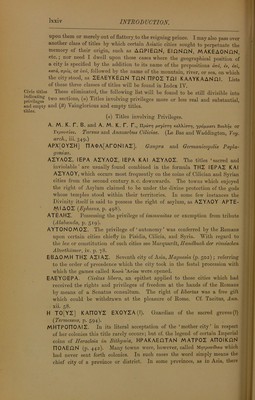
![upon them or merely out of flattery, to the reigning prince. I may also pass over another class of titles by which certain Asiatic cities sought to perpetuate the memory of their origin, such as AHPIE.QN, EinNHN, MAKEAONflN, etc.; nor need I dwell upon those cases where the geographical position of a city is specified by the addition to its name of the prepositions ano, tv, ini, Kara, npus, or vno, followed by the name of the mountain, river, or sea, on which the citystood, as ZEAEYKEHN TUN ITPOZ THI K AAYK AANfll. Lists of these three classes of titles will be found in Index IY. Civic titles These eliminated, the following list will be found to be still divisible into privileges ^w0 sec^ons) (“) Titles involving privileges more or less real and substantial, and empty and (/3) Vainglorious and empty titles, titles. (a) Titles involving Privileges. A. M. K. r. B. and A. M. K. T. r., IIpcoTr] peyicrTr) KaWlcrTrypappan BovXijs or r(povalas. Tarsus and Anazarbus Ciliciae. (Le Bas and Waddington, Voy. arcli., iii. 349.) APX[0 YZH] T7AcbA[ArONlAI]. Gangra and Germanicopolis Pagla- goniae. AZYAOZ, IEP A AZYAOZ, IEPA K AI AZYAOZ. The titles ‘sacred and inviolable ’ are usually found combined in the formula THZ IEPAZ KAI AZYAOY, which occurs most frequently on the coins of Cilician and Syrian cities from the second century b. c. downwards. The towns which enjoyed the right of Asylum claimed to be under the divine protection of the gods whose temples stood within their territories. In some few instances the Divinity itself is said to possess the right of asylum, as AZYAOY APPE- AL I AO Z (Ejrfiesus, p. 498). ATEAHZ. Possessing the privilege of immunitas or exemption from tribute (Alabancla, p. 519). AYTONOMOZ. The privilege of‘autonomy’ was conferred by the Romans upon certain cities chiefly in Pisidia, Cilicia, and Syria. With regard to the lex or constitution of such cities see Marquardt, Handbuch der romischen Alterthumer, iv. p. 78. EBAOMH THZ AZIAZ. Seventh city of Asia, Magnesia (p. 502); referring to the order of precedence which the city took in the festal procession with which the games called Kotrd ’Aalas were.opened. EAEYOEPA. Civitas libera, an epithet applied to those cities which had received the rights and privileges of freedom at the hands of the Romans by means of a Senatus consultum. The right of libertas was a free gift which could be withdrawn at the pleasure of Rome. Cf. Tacitus, Ann. xii. 58. H TO[YZ] KATTOYZ EXOYZA(l). Guardian of the sacred groves(?) (Termessus, p. 594). MHTPOTTOAIZ. In its literal acceptation of the ‘mother city’ in respect of her colonies this title rarely occurs; but cf. the legend of certain Imperial coins of Ileracleia in Bithynia, HPAKAEDTAN MATPOZ ATTOIKflN TlOAEflN (p.442). Many towns were, however, called M^rporroXfir which had never sent forth colonics. In such cases the word simply means the chief city of a province or district. In some provinces, as in Asia, there](https://iiif.wellcomecollection.org/image/b24858572_0078.jp2/full/800%2C/0/default.jpg)



 No text description is available for this image
 No text description is available for this image
 No text description is available for this image