Historia numorum : a manual of Greek numismatics / by Barclay V. Head.
- Barclay Vincent Head
- Date:
- 1887
Licence: Public Domain Mark
Credit: Historia numorum : a manual of Greek numismatics / by Barclay V. Head. Source: Wellcome Collection.
79/908 page 75
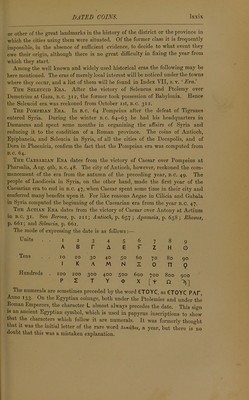
![CIVIC TITLES. were several M^rpo*6\*is, which is to be perhaps accounted for by the fact that such provinces were composed of several previously distinct parts, in many instances, however, the title MryrpoVoXis seems to have been gran e merely as an honorary distinction, probably in the case of the Province of Asia, to those towns in which the games called Koivd 'Ao-ias were celebrated. Similarly the title MjjrporroXir rfs 'lavias, applied to Miletus (Corp. Inscr. Att^ iii. 480), may be explained as referring to the Panionian Festival koiv'ov iy ■noXeav, kolvov naviauiov, or koiv'ov pr)Tpono\eiTCov rcbv iv Icovia, etc., common to the thirteen cities of the Ionian League. Another meaning must be assigned to Mfjrpo7roXis when there is reason to suppose that it was adopted fiom religious motives. It then means the * city of the mother,’ i. e. Kybele. Cf. the analogous names Diospolis, Letopolis, etc. |s| AY APX1Z was a title adopted by, or conferred by the Emperor upon, various maritime cities, such as Nicopolis in Epirus, Tomi in Moesia, Side in Pam- phylia, Aegae, Corycus, and Sebaste in Cilicia, Bora, Sidon, and Tripolis in Phoenicia, 011 account of their convenience as naval stations or of their naval importance in their several provinces. NEGKOPOZ, probably ‘ Temple-Keeper,’ was a title applied to those whose function it was to keep in repair the sacred edifices and generally to super- intend all affairs connected with the due observance of the sacred rites and ceremonies, and to safeguard the temple treasury. The office of Neokoros was a dignity often conferred upon the highest magistrates of the State, such as Archons, Strategi, Prytaneis, Grammateis, etc. As an honorary title it was also commonly adopted by the city itself. Of this practice the Imperial coinage affords ample evidence, as does also the well-known passage in the Acts of the Apostles (xix. 35), LVi'Spes ’E^eVtot, ris yap ianv dvdpcoTros os ov yivaaKei ttiv'E^otlcov n6\iv vecoKopov ovcrav rrjs peyd\T]s deas 'Aprepibos Kai rov AtorreroGs' ; So also when temples were erected and altars set up in honour of the Eoman Emperor and of the Imperial city, the servile Greek towns of Asia sought and usually obtained permission to style themselves NEGKOPOI, the words TON ZEBAZTGN being either expressed or understood. The Imperial Neokorate probably carried with it the right of presidency at the Augustan Festivals (ZEBAZMIA) and the duty of providing for the expenses of the sacrifices and games appertaining thereto. From time to time the Neokorate appears to have been conferred afresh upon the more illustrious cities. Thus Ephesus in the reign of Claudius is simply NEGKOPOZ, from Hadrian to Caracalla AIZ NEGKOPOZ, then under Caracalla TPIZ NEGKOPOZ, and in the time of Elagabalus TETPAKIZ NEGKOPOZ, and then again TPIZ NEGKOPOZ under Maximinus. A similar return to a lower number after a higher had already been in use has been noticed at several cities. Eckhel suggests in explanation, that a Neokorate conferred by a deceased Emperor whose name was no longer held in honour may have been suppressed or eliminated, either because its con- tinued observance involved too heavy an expense, or perhaps to flatter the new Emperor, to whom the mention of benefits conferred by his predecessor may not always have been acceptable.](https://iiif.wellcomecollection.org/image/b24858572_0079.jp2/full/800%2C/0/default.jpg)



 No text description is available for this image
 No text description is available for this image
 No text description is available for this image