Historia numorum : a manual of Greek numismatics / by Barclay V. Head.
- Barclay Vincent Head
- Date:
- 1887
Licence: Public Domain Mark
Credit: Historia numorum : a manual of Greek numismatics / by Barclay V. Head. Source: Wellcome Collection.
90/908 page 6
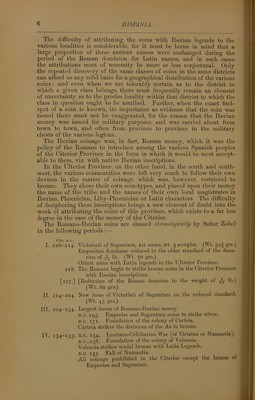
![The difficulty of attributing the coins with Iberian legends to the various localities is considerable, for it must be borne in mind that a large proportion of these ancient names were exchanged during the period of the Roman dominion for Latin names, and in such cases the attributions must of necessity be more or less conjectural. Only the repeated discovery of the same classes of coins in the same districts can afford us any solid basis for a geographical distribution of the various coins; and even when we are tolerably certain as to the district to which a given class belongs, there must frequently remain an element of uncertainty as to the precise locality within that district to which the class in question ought to be ascribed. Further, when the exact find- spot of a coin is known, its importance as evidence that the coin was issued there must not be exaggerated, for the reason that the Iberian money was issued for military purposes, and was carried about from town to town, and often from province to province in the military chests of the various legions. The Iberian coinage was, in fact, Roman money, which it was the policy of the Romans to introduce among the various Spanish peoples of the Citerior Province in the form in which it would be most accept- able to them, viz. with native Iberian inscriptions. In the Ulterior Province, on the other hand, in the south and south- west, the various communities were left very much to follow their own devices in the matter of coinage, which was, however, restricted to bronze. They chose their own coin-types, and placed upon their money the name of the tribe and the names of their own local magistrates in Iberian, Phoenician, Liby-Phoenician or Latin characters. The difficulty of deciphering these inscriptions brings a new element of doubt into the work of attributing the coins of this province, which exists to a far less degree in the case of the money of the Citerior. The Romano-Iberian coins are classed chronologically by Senor Zobel in the following periods :— I. II. III. IV. Circ. e. c. 226-214. 2 18. [217 •] 214-204. 204-154. Vietoriati of Saguntum, 1st series, wt. 3 scruples. (Wt. 52^ grs.) Emporitan drachmae reduced to the older standard of the dena- rius of J-.j lb. (Wt. 70 grs.) Oldest coins with Latin legends in the Ulterior Province. The Romans begin to strike bronze coins in the Citerior Province with Iberian inscriptions. [Reduction of the Roman denarius to the weight of -fa lb.] (Wt. 60 grs.) New issue of Vietoriati of Saguntum on the reduced standard. (Wt, 45 grs.) Largest issues of Romano-Iberian money. B.c. 195. Emporiae and Saguntum cease to strike silver. B.c. 171. Foundation of the colony of Carteia. Carteia strikes the divisions of the As in bronze. 154~133- b.c. 154. Lusitano-Celtiberian War [of Viriatus or Numantia]. b.c. 138. Foundation of the colony of Valencia. Valencia strikes uncial bronze with Latin Legends. B.c. 133. Fall of Numantia. All coinage prohibited in the Citerior except the bronze of Emporiae and Saguntum.](https://iiif.wellcomecollection.org/image/b24858572_0090.jp2/full/800%2C/0/default.jpg)


 No text description is available for this image
 No text description is available for this image
 No text description is available for this image