The perfected prismometer : its practical advantages, construction, and various applications / by C.F. Prentice.
- Prentice, Charles F. (Charles Frederick), 1854-
- Date:
- [1891]
Licence: Public Domain Mark
Credit: The perfected prismometer : its practical advantages, construction, and various applications / by C.F. Prentice. Source: Wellcome Collection.
Provider: This material has been provided by The Royal College of Surgeons of England. The original may be consulted at The Royal College of Surgeons of England.
16/20 page 120
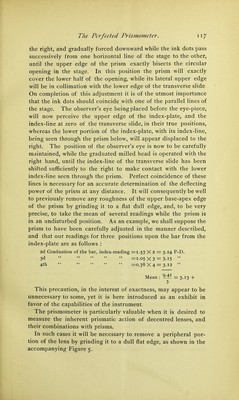
![It is therefore only necessary to divide the magnified or dimin- ished readings by D. The value of D, as we have seen, is determined by first centring the lens. It will have a different value for different lenses, and will depend upon the distance of the lens from the index-plate. In fact, D represents the magnifying or diminishing power of lenses for any position of an object, when viewed through them and which may be placed within their respective focal distances. For the 3-D convex lens, at the graduation upon the bar marked 3, measurement by the instrument shows D to be equal to 1.2, Fig. 7. Suppose we decentre a -f- 3-D lens until we obtain a reading say of 0.6 P-D, which is of course a magnified reading we then have = °' (magnified reading) = 0.5 normal P-D at the distance 3, or 1.5 normal P-D at the meter-plane. In measuring sphero-prismatic lenses we shall therefore find that the value of the constant prism can either be increased or diminished by a decentration of the lenticular element of the combination, a decentration of 5 mm in the above instance being sufficient to contribute 1.5 P-D. ad- or ab-ductive as occasion may demand. By such means it will be possible to counteract the inaccuracies which invariably exist in the constant prism after the combination has been ground. When the lens is combined with a prism the flattened dull edge should be cut parallel with the true base-apex ine, the latter being registered with ink dots and adjusted upon the stage as usual. The most ready means of measuring such a combination—for example, + 3 D spherical combined with 2 P-D (constant prism) — wil] be to place the index-plate at the distance upon the bar marked 3, when, as before, the lens magnification D — 1.2, and which may be more conveniently determined by pre- viously centring a spherical lens of the same refraction. Now, by deductive reasoning, we know that 2 normal prism-dioptries will be equal to f P-D at \ the distance, and this would require to be 1.2 greater at the same distance to appear as the properly propor- tioned magnified deflection seen through the lens, consequently § 1.2 == 0.8 magnified prism-dioptries. We therefore set the line of the transverse slide so as to read 0.8 P-D at the distance marked three ( 3 ) upon the bar, and proceed to decentre the lens until the lower index-line cuts it, when we shall have the desired 2 normal prism-dioptries. We may utilize the rule to](https://iiif.wellcomecollection.org/image/b22275356_0018.jp2/full/800%2C/0/default.jpg)


 No text description is available for this image
 No text description is available for this image
 No text description is available for this image