Licence: Public Domain Mark
Credit: An introduction to therapeutic inoculation. Source: Wellcome Collection.
Provider: This material has been provided by the Harvey Cushing/John Hay Whitney Medical Library at Yale University, through the Medical Heritage Library. The original may be consulted at the Harvey Cushing/John Hay Whitney Medical Library at Yale University.
31/206 page 9
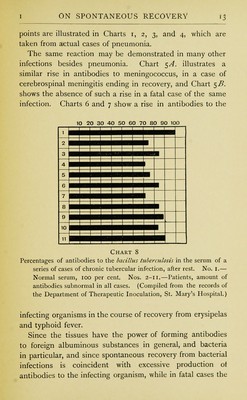
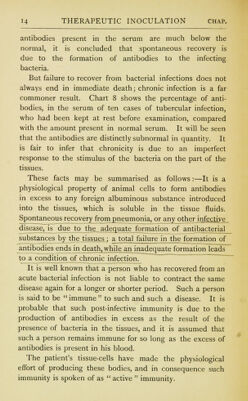
![antibodies, in excess of the amount required to counteract the stimulus, and this increase can be demonstrated in his serum. That is, the result of a suitable inoculation with bacteria is apparent [rather as an increase in the amount of a substance normally present than in the development of a new substance.] The antibacterial properties of serum, and their increase after inoculation, are well illustrated by the action of human serum on the bacillus typhosus. If a volume of a broth culture of typhoid bacilli which contains ten million organisms per cubic centimetre is incubated with an equal volume of normal serum, the bacilli will all be killed, and if the mixture is subsequently planted out on agar no growth will result.1 If the culture is appreciably stronger than this, containing, say, twenty million bacilli, the antibacterial sub- stances will be insufficient to kill all the bacteria, and when the mixture is planted out, some colonies will grow. But if the serum of a person who has been successfully inoculated with typhoid bacilli is employed, an equal volume of a broth culture containing one hundred million bacilli per cubic centimetre will be rendered sterile. This is proof that the tissues have been stimulated to an increased formation of antibacterial substances, and that the latter have been increased tenfold. This phenomenon, which is known as the bactericidal reaction, is very clear evidence of an increase in anti- body-formation, but it is one which can be demonstrated in vitro with only a few varieties of bacteria; with staphy- lococci for instance, no such reaction can be shown. There 1 In practice a broth culture of typhoid bacilli, of twelve hours' growth, is taken, progressive dilutions of I in 10, I in ioo and so on are made, and a series of bactericidal experiments are made with the different strengths, only very small amounts being actually used. It is estimated, however, that the volume of culture which is sterilised by the addition of an equal volume of normal serum contains ten million bacilli per c.c.](https://iiif.wellcomecollection.org/image/b21018406_0031.jp2/full/800%2C/0/default.jpg)