The systematic use of cylinders in making the shadow test / by Alexander Duane.
- Alexander Duane
- Date:
- 1903
Licence: In copyright
Credit: The systematic use of cylinders in making the shadow test / by Alexander Duane. Source: Wellcome Collection.
Provider: This material has been provided by The Royal College of Surgeons of England. The original may be consulted at The Royal College of Surgeons of England.
3/6 page 1
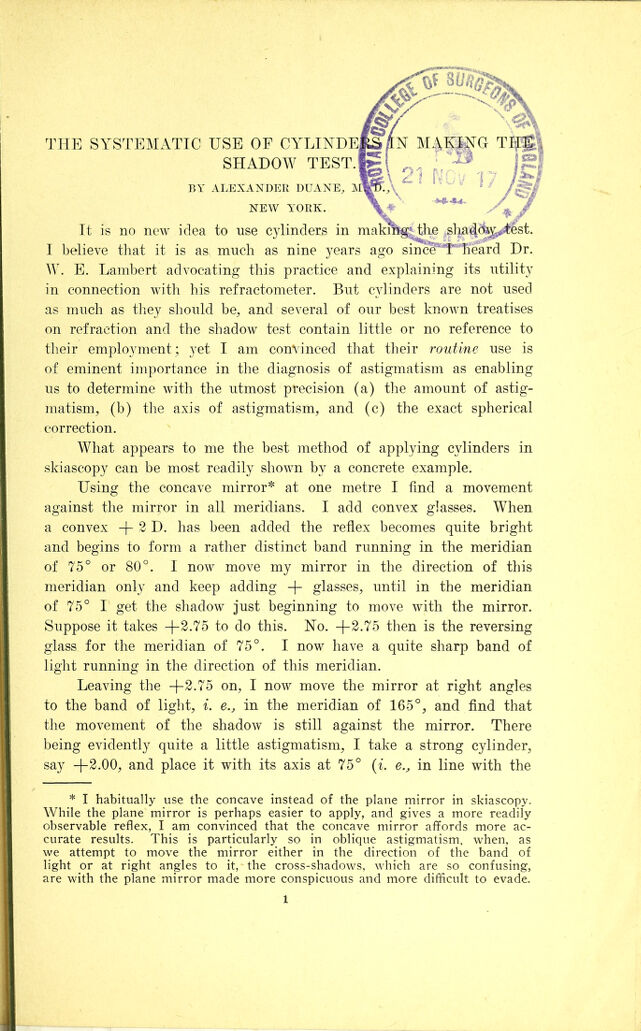
![SHADOW TEST. BY ALEXANDER DUANE, ]\ NEW YORK. It is no new idea to nse cylinders in maki54g!;The .shadd^^-test. I believe that it is as mucli as nine years ago sinc^U Heard Dr. E. Lambert advocating this practice and explaining its utility in connection with his refractometer. But cylinders are not used as much as they should be, and several of our best known treatises on refraction and the shadow test contain little or no reference to their employment; yet I am convinced that their r^outine use is of eminent importance in the diagnosis of astigmatism as enabling us to determine with the utmost precision (a) the amount of astig- matism, (b) the axis of astigmatism, and (c) the exact spherical correction. What appears to me the best method of applying cylinders in skiascopy can be most readily shown by a concrete example. Using the concave mirror^ at one metre I find a movement against the mirror in all meridians. I add convex glasses. When a convex -j- 2 D. has been added the reflex becomes quite bright and begins to form a rather distinct band running in the meridian of 75° or 80°. I now move my mirror in the direction of this meridian only and keep adding glasses, until in the meridian of 75° I get the shadow just beginning to move with the mirror. Suppose it takes to do this. No. -j-2.75 then is the reversing glass for the meridian of 75°. I now have a quite sharp band of light running in the direction of this meridian. Leaving the +2.75 on, I now move the mirror at right angles to the band of light, i. e., in the meridian of 165°, and find that the movement of the shadow is still against the mirror. There being evidently quite a little astigmatism, I take a strong cylinder, say +2.00, and place it with its axis at 75° {i. e., in line with the * I habitually use the concave instead of the plane mirror in skiascopy. While the plane mirror is perhaps easier to apply, and gives a more readily observable reflex, I am convinced that the concave mirror affords more ac- curate results. This is particularly so in oblique astigmatism, when, as we attempt to move the mirror either in the direction of the band of light or at right angles to it, the cross-shadows, which are so confusing, are with the plane mirror made more conspicuous and more difircult to evade.](https://iiif.wellcomecollection.org/image/b22449668_0005.jp2/full/800%2C/0/default.jpg)