The principles and practice of obstetrics / by Hugh L. Hodge.
- Hugh Lenox Hodge
- Date:
- 1864
Licence: Public Domain Mark
Credit: The principles and practice of obstetrics / by Hugh L. Hodge. Source: Wellcome Collection.
Provider: This material has been provided by the National Library of Medicine (U.S.), through the Medical Heritage Library. The original may be consulted at the National Library of Medicine (U.S.)
10/630
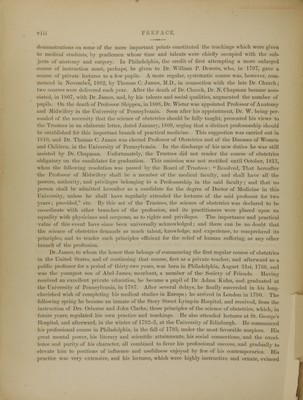
![of parturition is becoming more apparent) and obstetrics is now universally recognized as a dinate branch of the Bcienoe of medicine. This acknowledgment has been slowly made, even l.\ members of the profession. We find that, as late as 1826, Dr. Ramsbotham, junior, and Borne thirt) teachers and practitioners of obstetrics, had to unite their exertions, for a series of years, in London, to obtain fellowship with the College of Physicians, and the declaration that a knowledge of obstetrics Bhould be rendered obligatory upon all candidates for medical honors. At the commencement of the last century, obstetrics in the United States was regarded alto- gether as a subordinate branch of medicine; its practice was entrusted to women, and it was onU in cases of tedious and dangerous labors that the assistance of the surgeon was required. Nevertheless, in our large cities at least, there were many practitioners so well indoctrinated in the principles of obstetrics, as then understood, that the}- could afford important aid to the parturient, woman. There were, however, many young Americans of talent, whose love of knowledge induced them to visit European schools, that they might be prepared to practice their profession at home. Some of these devoted special attention to midwifery. We may mention, in this connec- tion. Dr. .lames Lloyd, a graduate of Harvard University, who attended the lectures of Dr. Smellie, of London, receiving from this distinguished teacher a testimonial of his industry and proficiency, and. after his return home to Boston, in 1752, devoted himself, most successfully and acceptably, to the practice of obstetrics for many years. He died in 1810, aged eighty-two years. Dr. Thomas Bond, anil his brother, Dr. Phineas Bond, were born in Maryland, and completed their medical education in European schools, chiefly at Paris. They settled in Philadelphia, where they practiced their profession for many years, and were associated with the founders of our medical schools and hospitals. Dr. Gustavus R. Brown, of Charles County, Maryland, was educated at Edinburgh, and graduated in 1768. His nephews, Drs. Gustavus and William Brown, and also Dr. Parham, of Maryland, all received their medical education in Europe. Dr. Walter Jones, of Northumberland County. Virginia, graduated in 1770, at Edinburgh, and, on his return, obtained a great reputation for talent and attainments. In South Carolina, Dr. William Bull, son of the Lieutenant-Governor of that province, visited Holland, to attend the lectures of Boerhaave, and became the fellow-student of Van Swieten. who speaks of him as the learned Dr. Bull. Of all the young Americans, there were none more distinguished, or whose labors had a more important influence upon the progress of medical science, than Dr. William Shippen, junior, and Dr. John Morgan, both of Philadelphia, who became the founders of the Medical College of Philadel- phia, now the University of Pennsylvania. Dr. Shippen was the son of Dr. William Shippen, senior, and was born in 1736. He studied anatomy and surgery in England under the superin- tendence of Mr. John Hunter, and midwifery under the direction of Dr. William Hunter, and also of Dr. McKenzie. then an influential practitioner of midwifery in London. He returned to Philadelphia in the spring of 1702, and in the fall of the same year commenced a course of lectures upon anatomy, surgery, and midwifery, and thus laid the foundation of the first regular course of medical instruction in the United States. Dr. John Morgan was a contemporary of Dr. Ship]ten, and also a disciple of Dr. William Hunter, but completed his medical education at the College of Edinburgh After travelling extensively in Europe, and becoming acquainted with many of the dis- tinguished men of that age. including the celebrated Morgagni, of Italy, he returned home in 17G5. In accordance with a previous agreement, he and Dr. Shippen presented a plan to the Philadelphia College, of adding a medical department to that institution. The trustees readily acceded to this proposition, and appointed Dr. Morgan. Professor of the Theory and Practice of Medicine, and Dr. Shippen. Professor of Anatomy. Surgery, and Midwifery. Their first united course of lectures was](https://iiif.wellcomecollection.org/image/b21128893_0010.jp2/full/800%2C/0/default.jpg)