Volume 1
William Harvey : a history of the discovery of the circulation of the blood / by R. Willis ; With a portrait of Harvey, after Faithorne.
- Robert Willis
- Date:
- 1878
Licence: Public Domain Mark
Credit: William Harvey : a history of the discovery of the circulation of the blood / by R. Willis ; With a portrait of Harvey, after Faithorne. Source: Wellcome Collection.
57/416 page 37
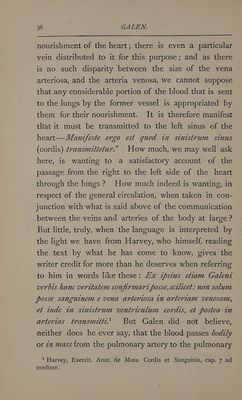
![vein. The blood of the pulmonary artery he believed went mainly to nourish the lungs: it was a certain portion of it only that reached the pulmonary vein by the anastomoses which he imagined to exist between the two vessels throughout their whole course, and not by their extremities only, as we understand matters. This interpretation of Galen’s idea of the pulmonary physiology, is fully confirmed by what is said in the sixth chapter of the tenth book De usu Partium: “When the thorax contracts, the pulse [here taken for the heart and great vessels], the lungs, and all they contain, being much compressed, the spirit within the arteria venosa is forced out at a great rate, but a certain quantity of blood is at the same time trans- ferred to it by those same subtle orifices. This, how- ever, could not happen were the blood free to flow back to the heart by the ample outlet of the vena arterialis. But return by this being prevented, the compression that is suffered on all sides, forces some- thing to distil by the minute orifices.” The pulmonary veins therefore transude spirit on the one hand, and receive something—quidpiam, viz. a little blood, on the other. There is no question of any continuous transfusion from the right to the left 1“ Cym autem thorax contrahitur, pulse atque intro compress un- dique, que in pulmone sunt, venose arteriz, exprimunt quidem quam celerrime qui in ipsis est spiritum ; transumunt autem per subtilia illa oscilla sanguinis portionem aliquam. Quod nunquam accidisset pro- fecto, si sanguis per maximum os (cujusmodi est vene arteriosz) retro remeare potuisset. Nunc vero, reditu per os magnum intercluso, dum, comprimitur undique, distillat quidpiam per exigua illa orificia.”](https://iiif.wellcomecollection.org/image/b33703991_0001_0057.jp2/full/800%2C/0/default.jpg)



 No text description is available for this image
 No text description is available for this image
 No text description is available for this image