English vaccination and small pox statistics : with special reference to the report of the Royal Commission, and to recent small pox epidemics / by Noel A. Humphreys.
- Humphreys, Noel A.
- Date:
- [1897]
Licence: Public Domain Mark
Credit: English vaccination and small pox statistics : with special reference to the report of the Royal Commission, and to recent small pox epidemics / by Noel A. Humphreys. Source: Wellcome Collection.
11/38 page 10
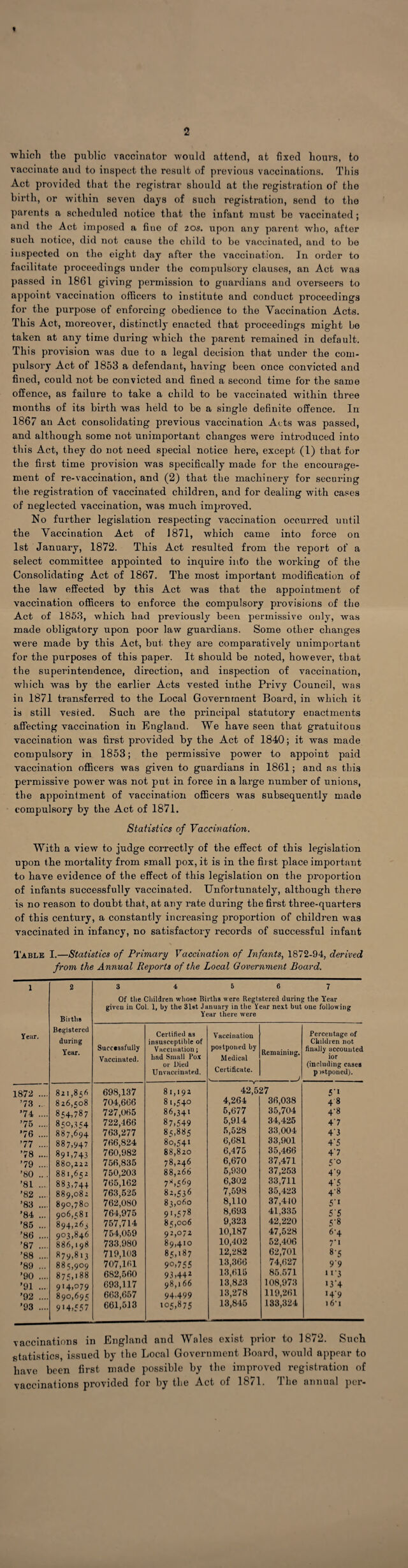
![This table shows that of 1,000 deaths from small pox, 677 occurred among children aged under 5 years of age in 1848-54, while the proportion in this age-period steadily declined in subse- qeQni^011ps of five years to .93 in 1885-89, and rose again to 283 in 1890-94, under the influence of the decrease of infant vaccination, due in great measure to the delay in the issue of the Report of e ommission. On the other hand the proportional numbers of small pox deaths among persons aged upwards of 15 years steadily rose from 160 per i‘ooo in 1848-54 to 704 in 1885-89, and fell again to 641 m 1890-94. To what can this complete bouleverse- meat of age-incidence be attributed if not to the undoubted increase in the proportion and efficiency of infant vaccination during the thirty years between the two periods we have com¬ pared Much ingenious sophistry was brought to bear upon this point by some of the Commissioners in cross-examining some of the witnesses, notably Dr. Ogle and Dr. Thorne Thorne who prominently brought out this fact in their evidence, and also by some of the anti-vaccination witnesses in their evidence. The facts, however, remain unchallenged, and inexplicable on any other suggested hypothesis than that the change of age-incidence is due to increased infant vaccination. It is, moreover, very noteworthy that in the minority report of Dr. Collins and Mr Picton, no explanation of this change of age-incidenee is attempted, although attention is called to the fact that in the nine years 1872-80, under the influence of compulsory vaccination “ at every age over 10 years the chance of dying of small pox '* was greater” than it had been in the six years 1848-53, when vaccination was voluntary. It would be interesting to know why Dr. Collins and Mr. Picton confined their comparison to the nine years ending with 1880, and to the ages above 10 years. It is at any rate, worth noting that if they had enlarged the period to a more recent date, still more if they had compared 1848-53 with say 1888-93, the result of the comparison would have been very different. } Before leaving this branch of the subject, namely, the evidence ot the effect of infant vaccination upon child mortality from small pox, it is necessary to refer to the important statistics given in the Commissioners’ Report relating to the age-incidence of the fatal cases of smallpox recorded at each of the six epidemics that occurred at Sheffield, Warrington, London, Dewsbury, Leicester and. Gloucester between 1887 and the present time. These statistics are here tabulated :— Table VI.—Child Mortality from Small Pox in relation to the Neqlect of PfidemicT m SiX T°WnS WkiCk ^ reC6ntly svffered fr°™ Small Pox [“Final Keport,” pp. 50 and 176.] 2 Date of Epidemic. 3 Total of Small Pox Deaths. 4 Percentage of Deaths under 10 to Total Deaths from Small Pox. 1892-93 62 225 ’87-88 *89 256 ’92-93 182 368 ’91-92 110 518 ’95-96 443 645 ’92-93 21 71-4* 1 Towns. Warrington Sheffield ... London. Dewsbury... Gloucester Leicester ... “ Unaccounted for ” as to Vaccination. 48 4‘5 9 9 ii'i 6y6 68-i 0 J i 111 11 scatter rever ward in close proxiir to the small pox hospital, this proportion would be reduced to 66‘6 per cent. The figures in ihis table show that in the ten years preceding the epidemic m Warrington, only 5 per cent, of the children born were unaccounted for as regards successful vaccination; in London the mean proportion of children not accounted for was 10 per cent.; in Dewsbury this proportion of unvaccinated children was 32 per cent., and both in Gloucester and Leicester it was so high as 68 per cent. If, as statistics previously dealt with suggest, the proportion of deaths from small pox among children depends ipon the proportion that has been vaccinated, the age-incidence during these six epidemics should show wide variations. This expecta Ition is abundantly fulfilled. In the well vaccinated towns of I Warrington and Sheffield only 23 and 26 per cent, respectively of the deaths occurred among children under 10 years of age; but this proportion was 37 per cent, in London, 52 in Dewsbury, 65 in Gloucester, and 71 in Leicester. These figures corroborate in a remarkable manner the evidence afforded by other statistics and seem to forbid disbelief in the assertion that small pox mortalify, at any rate among children, is directly governed by the proportion of successful vaccinations. It is true that the intensity of the mortality from small pox also varied verj widely in these six epidemics, and it is noteworthy that Dr. Collins and Mr. Picton endeavour to discredit vaccination by pointing out that in Leicester and Dewsbury, in which towns vaccination had been so persistently neglected, the rate of mortality from the disease was much lower than in Sheffield and Warrington, in which vaccination had been well carried out. Is the inference suggested that the mildness of the tjpe of the disease in Dewsbury and Leicester was due to the neglect of vaccination ? It is still more noteworthy that Dr. Collins, when dealing with the statistics of these epidemics,](https://iiif.wellcomecollection.org/image/b3055696x_0012.jp2/full/800%2C/0/default.jpg)