English vaccination and small pox statistics : with special reference to the report of the Royal Commission, and to recent small pox epidemics / by Noel A. Humphreys.
- Humphreys, Noel A.
- Date:
- [1897]
Licence: Public Domain Mark
Credit: English vaccination and small pox statistics : with special reference to the report of the Royal Commission, and to recent small pox epidemics / by Noel A. Humphreys. Source: Wellcome Collection.
7/38 page 6
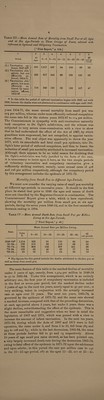
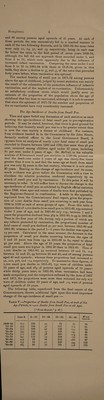
![Table III.—Mean Annual Rate of Mortality from Small Pox at all Ages and at Six Age-Periods in Three Groups of Fears, selected with reference to Optional and Obligatory Vaccination. [“ First Report,” p. 114.] 1 2 8 4 5 6 7 8 Period. All 0—5. 45 Ages. 5—10. 10—15 15—25. 25—45. and up¬ wards. (1.) Vaccination op-' tional, 1847-53* 305 1,617 337 y 94 109 66 22 (2.) Vaccination ohli-] gatory, but not efficiently en¬ forced, 1854-71 > 223 817 243 88 163 131 52 (3.) Vaccination obli-^ gatory, but more efficiently en¬ forced by vacci- > 114 242 120 69 122 107 47 nation officers, 1872-87 . * In this table the period of optional vaccination begins with 1847, not with 1838, because the deaths were not abstracted in combination with ages until 1847. years 1854-71, the mean annual mortality from small pox was 223 per million, whereas under more efficiently enforced compulsion the mean rate fell in the sixteen years 1872-87 to .114 per million. The Commissioners in sympathy with anti-vaccinators naturally took exception to llr. Ogle’s subdivision, and the witness was subjected to very severe cross-examination with a view to show that he had undervalued the effect of the Act of 1867, by which guardians were empowered, but not compelled, to appoint vaccin¬ ation officers. The real object was apparently to throw the year 1871, with its remarkable and fatal small pox epidemic, into Dr. Ogle’s later period of enforced compulsion, and thus to lessen the reduction of small pox mortality attributed to increased vaccination. Although there appears to be no valid reason for doubting that Dr. Ogle’s subdivision was fully justified by the facts of the case, it is unnecessary to insist upon it here, as the two simple periods of voluntary vaccination and compulsory vaccination give a sufficiently striking contrast, namely, mean annual rates of 408 and 126 per million respectively, although the compulsory period by this arrangement includes the epidemic of 1871-72. Mortality from Small Pox in different A ge-Periods. We must now consider the varying rates of small pox mortality at different age-periods in successive years. It should in the first place be stated that prior to 1848 the ages and causes of death were not classified by the Registrar-General in combination. The Commissioners’ Report gives a table, which is here reproduced, showing the mortality per million from small pox at six age- periods, during the seven years 1848-54, and in the four succeeding decennia ending in 1894. Table IV.—Mean Annual Death-Rate from Small Pox per Million Living at Six Age-Periodsr [“ Final Report,” p. 48.] Mean Annual Rate per Million Living. Years. Under 5. 5—10. 10—15. 15—25. 25—45. 45 and upwards. 1848-54* 1,514 323 91 110 69 24 ’55-64.... 789 210 69 119 88 36 ’65-74.... 783 333 142 267 221 88 ’75-84 . 128 63 46 82 77 34 ’85-94.... 50 15 11 24 32 19 * The figures for this period include the deaths attributed to chicken pox as well as those from small pox. The main feature of this table is the marked decline of mortality under 5 years of age, namely, from 1,514 per million in 1848-54 to 50 in 1885-94. Under this arrangement, which is an entirely arbitrary one, the first year of compulsory vaccination is included in the first or seven-year period, but the marked decline under 5 years of age in the next ten years, nearly equal to 50 per cent., is very striking, taken in conjunction with the actually increased rate at ages over 15 years. The next ten years, 1865-74, is governed by the epidemic of 1871-72, and the mean rate showed a marked increase, compared with that of the preceding decennium, at each age-period above 5 years, but under 5 years there was a slight decline, notwithstanding the effect of the epidemic. This is the more remarkable and suggestive when we bear in mind the legislation of 1867 and 1871, which was passed with a view to increase the amount of infant vaccination. In the next ten years, 1875-84, during which the Acts of 1867 and 1871 were in full operation, the rates under 5, and from 5 to 10, fell from 783 and 333 to 128 and 63 ; while in the last decennium, 1885-94, the rates at these periods further fell to 50 and 15 respectively. Above 10 years of age small pox rates showed, as has been pointed out, a very largely increased death-rate during the decennium 1865-74, owing to fatal effect of the epidemic in 1871-72 upon the adolescent and upon adults; in this period the rate per million rose to 142 in the 10—15 age period, 267 at the ages 15—25, 221 at 25—15,](https://iiif.wellcomecollection.org/image/b3055696x_0008.jp2/full/800%2C/0/default.jpg)