English vaccination and small pox statistics : with special reference to the report of the Royal Commission, and to recent small pox epidemics / by Noel A. Humphreys.
- Humphreys, Noel A.
- Date:
- [1897]
Licence: Public Domain Mark
Credit: English vaccination and small pox statistics : with special reference to the report of the Royal Commission, and to recent small pox epidemics / by Noel A. Humphreys. Source: Wellcome Collection.
9/38 page 8
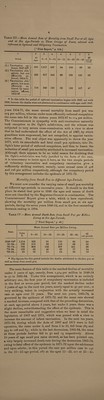
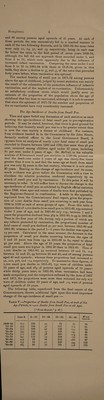
![Humphreys and 86 among persons aged upwards of 46 years. At each of these periods the rate successively fell in a marked manner in each of the two following decennia, and in 1886-94 the mean rates were only ii, 24, 32, and 19 respectively, being in each case fat below the rates in the first period of seven years 1848-54, although the fall did not approach those recorded under 5, and from 5 to 10, which were apparently due to the influence of increased infant vaccination. Comparing the rates under 5 and from 5 to 10 in 1885-94 with those in 1818-54, given in this table, they show a decline to ^ and °f the rates that prevailed forty years before, when vaccination was optional. lhe marked fatality of small pox in 1871-72 among persons above the age of childhood, judged by recent statistics, was mainly the lesult of the exhaustion of the protective influence of infantile vaccination, and of the neglect of re-vaccination. Unfortunately no satisfactory evidence exists which would justify even an estimate of the proportion of the population above the age of childhood that has been re-vaccinated, although it is safe to assume that since the epidemic of 1871-72 the number and proportion of the re-vaccinated have very considerably increased. The Age-Incidence of Deaths from Small Pox. Time and space forbid any discussion of such statistics as exist showing the age-incidence of fatal small pox in pi’e-registration periods. It may be stated, however, that there is good ground for believing that formerly small pox was to a far greater extent than is now the case mainly a disease of childhood. For instance, from evidence handed in to the Commission by Sir John Simon, formerly medical officer to the Local Government Board, it rppears from an analysis of nearly 7,000 fatal cases of small pox recorded in Geneva between 1580 and 1760, that more than 96 per cent, occurred among children aged under 10 years, including 81 per cent, under 5 years of age. Dr. McVail, in his valuable analysis of Kilmarnock small pox statistics in 1728-64, pointed out that the death-rate under 5 years of age was thirty-five times greater than it now is, and that the mean age at death from small pox was only 2^ years in the last century, whereas it is now about 20 years. Bearing on this change of age-incidence and its cause, much evidence was given before the Commission with a view to elucidate the relative protection conferred respectively by an attack of small pox and by vaccination. To this point it will be necessary to refer. It will suffice here to discuss the change in the age-incidence of small pox as exhibited by English official statistics since 1848, when ages and causes of deaths were first published by the Registrar-General in combination. A table in the appendix, reprinted from the Commissioners’ final report, gives the propor¬ tion of x,ooo deaths from small pox occurring in each year from 1848 to 1895 at each of seven groups of ages. From this table it appears that of 1,000 deaths from small pox in 1851-60, 239 occurred under 1 year of age, and in 1881-90 only 119; between 1 and 5 years the proportion declined from 363 in 1851-60, to 93 in 1881-90. Thus in the first year of life, during only a portion of which are any infants protected by vaccination, the proportional number of fatal cases of small pox declined 50 per cent, between 1851-60 and 1881-90, whereas in the period 1—5 years the decline was equal to 75 per cent. Calculated in the same manner, the decrease in the proportion of small pox deaths occurring between the ages of 5 and 10 years was from 134 in 1851-60 to 64, equal to about 50 per cent. Above the age of 10 years the proportion of fatal small pox cases was higher in 1881-90 than in 1851-60. Thus of r,ooo deaths in 1851-60, 35 occurred between 10 and 15, 103 between 15 and 25, 99 between 25 and 45, and 28 among persons aged 45 and upwards ; whereas these proportions had increased to 52, 222, 328, and 124 respectively. To summarise these figures, of 1,000 small pox deaths in 1851-60, 735 were of children under 10 years of age, and 265 of persons aged upwards of 10 years t while thirty years later, in 1881-90, when vaccination had been made compulsory, and the compulsion enforced by the Acts of 1867 and 1871, the proportions were more than reversed, for only 277 were of children under 10 years of age, and 723 were of persons aged upwards of 10 years. The following table, reproduced from the final report of the Commissioners, throws additional light upon this most important change of the age-incidence of small pox :— Table Y.—Proportion of Deaths from Small Pox, at each of Six Age-Periods, to 1,000 Deaths from Small Pox at all Ages. [“ Final Report,” p. 47.] Under 5. 6—10. 10—15. 15—25. 25—45. 45 and Upwards. J848-54 677 130 33 76 67 18 ’55-59 559 144 37 117 112 31 ’60-64 550 108 42 123 13 3 44 ’65-69 545 103 33 126 '45 48 ’70-74 312 140 58 200 224 66 ’75-79 241 113 72 218 266 90 ’80-84 235 98 68 216 286 97 ’85-89 193 54 51 229 344 129 ’90-94 50 26 131](https://iiif.wellcomecollection.org/image/b3055696x_0010.jp2/full/800%2C/0/default.jpg)