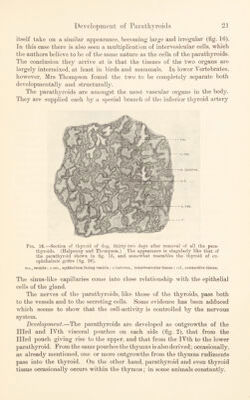
The endocrine organs : an introduction to the study of internal secretion / by Sir Edward A. Schäfer.
- Edward Albert Sharpey-Schäfer
- Date:
- 1916
Licence: In copyright
Credit: The endocrine organs : an introduction to the study of internal secretion / by Sir Edward A. Schäfer. Source: Wellcome Collection.
39/176 page 23
![or chronic: in the former clonic, in the latter tonic contractions of the muscles tend to manifest themselves. Tetany is without doubt due to deprivation of the parathyroids, for it will occur when these alone are removed. It varies greatly in severity and often takes on an intermittent character. The symptoms may remain latent for a considerable time, and only show themselves as the result of some unusual condition such as pregnancy. The effect is on the lower neurones, for according to Horsley it is not arrested by abla¬ tion of cerebral cortex. Lanz and Biedl state that it is increased on the side of the ablation; with cerebellar lesion they find an increase on the opposite side. According to Mustead, section of dorsal roots does not affect it. After spinal transection it disappears below the level of the lesion. Tetany is relieved by injection of parathyroid extract, and in many cases by administration of thyroid substance: it is uncertain if this last result is due to included parathyroid. When tetany is produced by total extirpation of all parathyroid tissues it can apparently only be cured by a successful graft of a parathyroid from an animal of the same species. The condition has been found to occur after complete removal of the thyro-parathyroid apparatus in man, and may be suffi¬ ciently serious to threaten life, unless suitable measures are taken to combat the effects of parathyroid loss.1 In order to prevent the accession of tetany in operations for removal of thyroid tumours it is usually necessary to leave at least two of the four parathyroids. In one dog experimented on by Edmunds, he found that a single parathyroid was sufficient to prevent the onset of tetany (the three others and both lobes of the thyroid having been removed): on extirpation of the remaining parathyroid the animal speedily developed tetany. Animals with insufficient amount of parathyroid tissue may not suffer from tetany under ordinary circumstances, but the symptoms may come on under special conditions. Thus Vassale observed, in a bitch from which three of the four parathyroids had been removed, that the animal was especially subject to fits of tetany during pregnancy 2 and lactation. The character of the food also influences the onset of the symptoms, flesh foods being much more apt to bring on the condition than a vegetable or milk diet. 1 A case in which all possible remedies, and grafts from various animals, including a monkey, were tried without avail, but which was ra]3idly and completely cured by the implantation into the subcutaneous tissue of parathyroids obtained fresh from the dead- house, is described by W. H. Brown in the Annals of Surgery, vol. liii., 1911. In ex¬ periments on animals it has been almost universally found that to ensure the success of a graft of parathyroid it must be derived from the same animal from which the parathyroids have been removed (Halsted and others). 2 This is contrary to what might be expected, considering that the mother would have had the parathyroids of the foetuses to draw upon. It seems, however, to be confirmed by the results of other experiments on dogs, and also by those of Adler and Thaler upon partially parathyroidectomised rats. Animals which have suffered complete parathyroidec¬ tomy do not become pregnant.](https://iiif.wellcomecollection.org/image/b29928886_0039.jp2/full/800%2C/0/default.jpg)