The chemistry of essential oils and artificial perfumes / by Ernest J. Parry.
- Parry, Ernest J. (Ernest John)
- Date:
- 1908
Licence: In copyright
Credit: The chemistry of essential oils and artificial perfumes / by Ernest J. Parry. Source: Wellcome Collection.
Provider: This material has been provided by UCL Library Services. The original may be consulted at UCL (University College London)
56/594 page 44
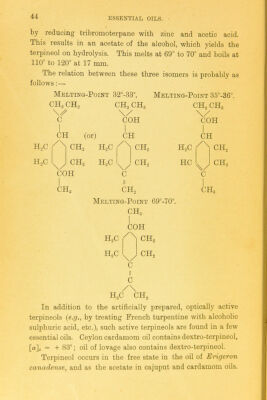
![by reducing tribromoterpane with zinc and acetic acid. This results in an acetate of the alcohol, which yields the terpineol on hydrolysis. This melts at 69° to 70° and boils at 110° to 120° at 17 mm. The relation between these three isomers is probably as follows:— Melting-Point 32°-33°. CH3 CH2 CH3 CH3 \s \y C COH Melting-Point 35°-36°. CH3 CH3 COH CH (or) H2C /X CH2 H2C CH2 H2C COH CH CH2 CH, H2C HC CH /\ CH, C CH2 CH, C I CHS CH, Melting-Point 69°-70°. CH3 I COH H2C /X CH2 H,C c CH, C H3C CH, In addition to the artificially prepared, optically active terpineols (e.g., by treating French turpentine with alcoholic sulphuric acid, etc.), such active terpineols are found in a few essential oils. Ceylon cardamom oil contains dextro-terpineol, [a]d = + 83°; oil of lovage also contains dextro-terpineol. Terpineol occurs in the free state in the oil of Erigeron canadense, and as the acetate in cajuput and cardamom oils.](https://iiif.wellcomecollection.org/image/b21687596_0056.jp2/full/800%2C/0/default.jpg)